There is no single way to avoid every STI, but layering the right tools gives excellent protection. A Specialist GP can build a prevention plan that fits your life over a quick phone call, covering condoms, testing, vaccination, PrEP, PEP and more.
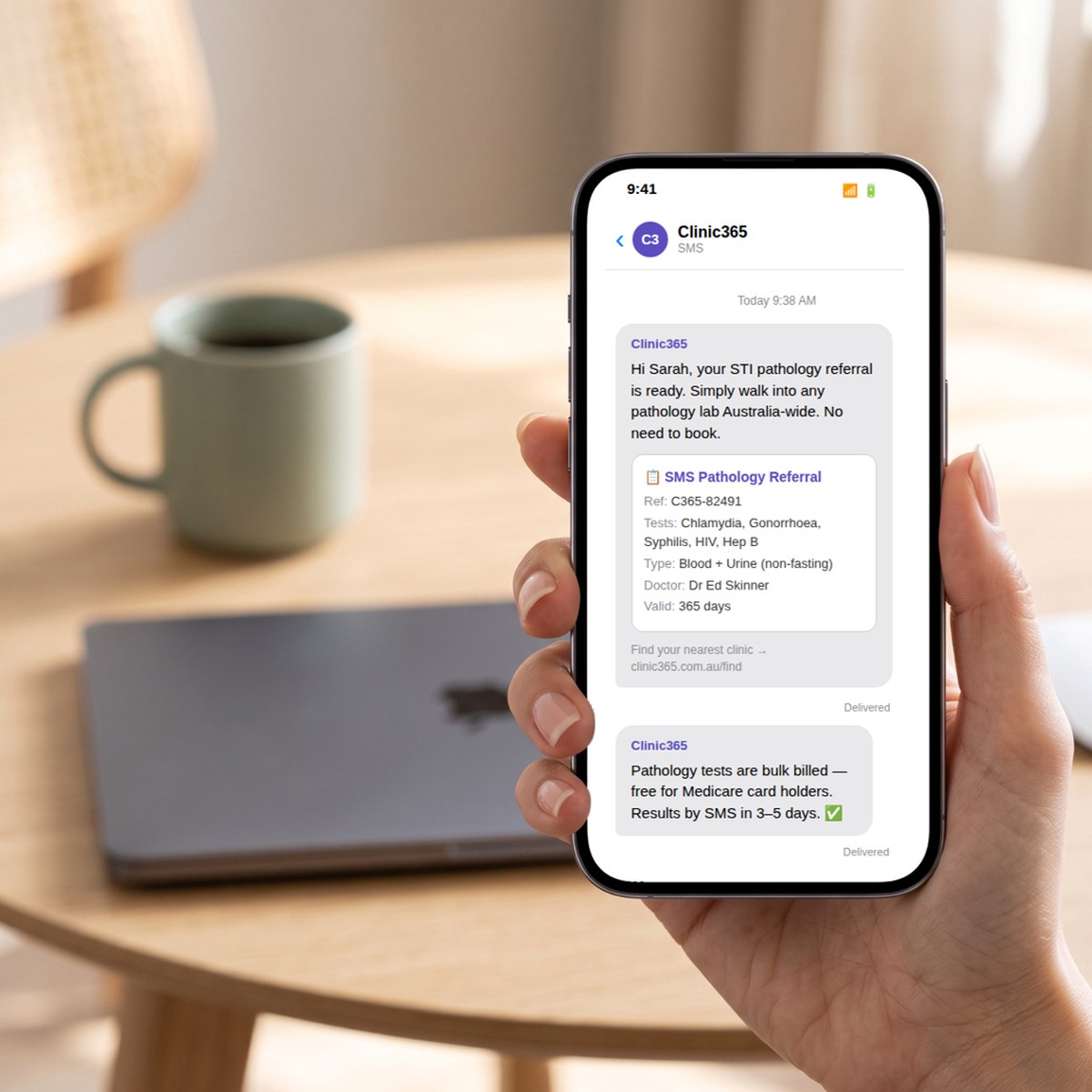
A Specialist GP calls you and sends your pathology request by SMS.
📞 “Hi, it’s Clinic365!”
2
Walk in to any lab
Any pathology collection centre, Australia-wide.
📍 Australia-wide
3
Results by SMS
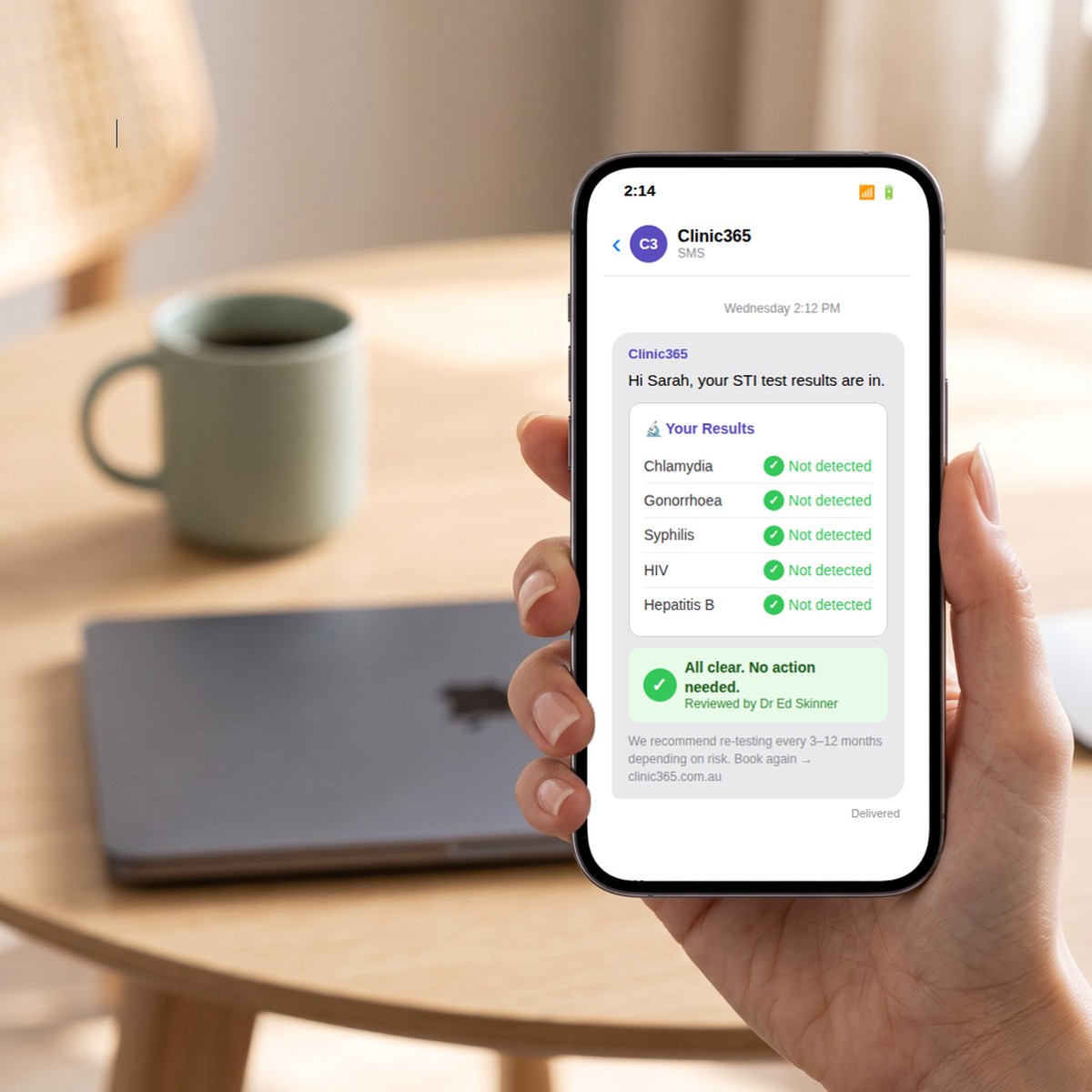
Usually within 2–3 days. If anything needs treatment, we call you.
✅ “Your results are ready”
🧭 Overview
STIs and STDs: A Layered Approach to Prevention
The most useful thing to understand about STI prevention is that no single method covers everything. Condoms are excellent but do not cover every infection or every act; vaccines protect against specific infections only; PrEP prevents HIV but not other STIs. The trick is not to find one perfect solution, it is to layer several methods so that where one has a gap, another fills it. Think of it as a toolkit rather than a single rule.
The right combination is personal. It depends on your life, your relationships, and what you are comfortable with, and it can change over time. This page runs through the main tools so you can put together an approach that works for you, ideally with a clinician who can tailor it to your situation.
🛡 Condoms
Condoms and Barriers
Condoms are the foundation of STI prevention, and for good reason: used correctly and consistently, they substantially reduce the risk of most STIs, including chlamydia, gonorrhoea, HIV and others, and they are cheap, accessible and effective. Both external (worn on the penis) and internal condoms work well. For oral sex, a dam (a thin latex square) offers protection.
The one thing to be realistic about is that condoms reduce risk rather than eliminate it, and they are less protective against infections spread by skin-to-skin contact of areas a condom does not cover, such as herpes, genital warts (HPV) and syphilis sores. That is not a reason to skip them, they remain one of the best tools available, but it is a reason to combine them with the other measures below.
🩺 Testing
Regular STI Testing
Testing is prevention. Because most STIs cause no symptoms, regular STI testing is the only way to know your status, and knowing it means an infection gets treated early, before it can be passed on or cause harm. A good rule of thumb is a sexual health check at least once a year if you are sexually active, and more often (every three to six months) if you have new or multiple partners. Testing when you start a new relationship, so both partners know where they stand, is one of the most practical prevention steps there is.
Test, don't guess. You cannot tell by looking, at yourself or a partner, whether an STI is present, because so many are silent. Regular testing takes the guesswork out and is a normal, responsible part of looking after your health.
⏰ How Often
How Often Should You Test?
There is no one-size-fits-all answer. How often you should have a sexual health check depends on your situation. As a general guide:
Your situation
Suggested testing frequency
Sexually active with one regular partner
At least once a year
Starting a new relationship or new partner
Test with each new partner, ideally both partners before condomless sex
Symptoms, a possible exposure, or a partner diagnosed
Straight away (mind window periods, below)
After being treated for an STI, a repeat test is often recommended too, for example a chlamydia retest around three months later to catch reinfection, which is common. A Specialist GP can suggest a schedule that fits your life, so testing becomes a simple routine rather than something you only think about when worried.
📅 Window Periods
Window Periods: When a Test Becomes Reliable
A window period is the gap between when you are exposed to an infection and when a test can reliably detect it. It matters because testing too early, before the window has passed, can miss a recent infection and give a falsely reassuring negative result. Different infections have different windows:
Infection
When a test becomes reliable
Chlamydia and gonorrhoea
About 2 weeks after exposure
Mycoplasma genitalium, trichomoniasis
About 2 weeks (or when symptomatic)
HIV
Around 6 weeks on the standard lab blood test, occasionally confirmed at 3 months
Syphilis
Up to 6 weeks, sometimes up to 3 months
Hepatitis B and C
Up to 3 months (hepatitis C antibodies can take up to about 12 weeks)
Herpes
Best tested by swabbing a sore while present; antibody blood tests can take up to 3 to 4 months and are not routine
A practical approach: a check about 2 weeks after a possible exposure covers chlamydia and gonorrhoea, while HIV and syphilis are repeated at around 6 weeks (and sometimes 3 months) to be conclusive. A negative test done very soon after an exposure is not the final word, it may need repeating once the window has passed. Two important exceptions: if you have symptoms, get tested straight away regardless of timing; and if you have taken PEP after an HIV exposure, your testing schedule is adjusted, so follow your clinician's advice.
💉 Vaccination
Vaccination
Some STIs can be prevented outright with a vaccine, one of the most powerful forms of prevention, because it stops an infection before there is any exposure to worry about:
HPV, the HPV vaccine (Gardasil 9) protects against the types of human papillomavirus that cause most genital warts and cervical and other cancers. It is part of the school program and available to many adults too.
Hepatitis B, a highly effective vaccine, part of routine childhood immunisation and available to adults who missed it. See hepatitis testing.
Mpox, the mpox vaccine is recommended for those at higher risk.
Hepatitis A, recommended for some people at higher risk.
If you are not sure which vaccines you have had or might benefit from, it is worth asking. Catching up on vaccination is a simple, lasting piece of your prevention plan.
💊 PrEP
PrEP: Preventing HIV
PrEP (pre-exposure prophylaxis) is medicine taken by people who do not have HIV to protect them from getting it. Taken as prescribed, it is highly effective at preventing HIV, one of the most significant advances in prevention in decades. It is usually a daily tablet, with longer-acting injectable forms emerging. PrEP is an excellent option for people at higher risk of HIV, and because it works independently of condoms, it is a valuable layer to combine with them. It protects against HIV only though, not other STIs, so it is used alongside condoms, testing and the other tools here, not instead of them.
🚨 PEP
PEP: Emergency Prevention After Exposure
PEP (post-exposure prophylaxis) is emergency medicine that can prevent HIV after a possible exposure, for example a condom breaking, or sex without protection with someone whose status you do not know. The critical thing about PEP is timing: it must be started as soon as possible, and within 72 hours of the exposure, then taken for about four weeks.
Do not wait. If you think you have been exposed to HIV, seek care urgently, including through an emergency department after hours. PEP is a safety net for when something goes wrong, not a routine method.
💊 DoxyPEP
DoxyPEP: Reducing Bacterial STIs
DoxyPEP is a newer prevention approach where a single dose of the antibiotic doxycycline is taken after sex to reduce the risk of certain bacterial STIs, principally syphilis, and to some extent chlamydia. It is recommended for specific higher-risk groups rather than everyone, and it is used under medical guidance because of the need to use antibiotics carefully. If you have frequent bacterial STIs, it is worth asking a clinician whether DoxyPEP might be appropriate for you as one part of your prevention plan.
👥 Partners
Treating Partners: Stopping the Cycle
Preventing STIs is not only about protecting yourself before exposure, it is also about stopping infections spreading once they are found. If you are diagnosed with an STI, making sure recent partners are tested and treated prevents them from being harmed, from passing it on further, and from reinfecting you. For chlamydia in particular, partner treatment can sometimes be arranged without your partner needing their own appointment. Completing your own treatment and avoiding sex until it is finished are equally important parts of not passing an infection on.
✅ U=U
Treatment as Prevention (U=U)
One of the most important developments in HIV prevention is the understanding summed up as U=U: Undetectable = Untransmittable. A person living with HIV who is on effective treatment, with the virus suppressed to undetectable levels in their blood, cannot pass HIV on to sexual partners. This is well established and transformative: it means HIV treatment is also HIV prevention. It is a powerful reason that testing and early treatment matter, not just for the person treated, but for preventing onward transmission entirely.
💬 Talking
Talking With Partners
Communication is an underrated prevention tool. Talking with a partner about testing, status and protection before sex can feel awkward, but it is one of the most effective things you can do, and it gets easier with practice. A simple "when were you last tested?" or "I get checked regularly, want to get tested together?" normalises it. Agreeing together on how you will protect yourselves, and being honest about symptoms or recent tests, means you are both making informed choices. Good communication does not replace the other tools, but it makes all of them work better.
📋 Practical Steps
Other Practical Steps
A few more measures round out your prevention toolkit:
Do not have sex while you or a partner has symptoms, such as sores, unusual discharge or a rash, until it has been checked.
Avoid sex during treatment for an STI until you and any partner have completed it and been advised it is safe.
Cover or clean sex toys between uses and between partners.
Never share needles or other injecting equipment, which can transmit HIV and hepatitis.
Consider your overall sexual health, fewer concurrent partners and mutual testing within a relationship both reduce exposure, without any judgement about how anyone chooses to live.
🧩 Your Plan
Building Your Own Prevention Plan
Putting it together, a solid prevention plan usually combines several of these: using condoms, testing regularly, being up to date on vaccines, considering PrEP if you are at higher risk of HIV, knowing about PEP as a backup, treating partners when needed, and communicating openly. You do not have to use every tool, the point is to choose a combination that covers your situation and that you will actually stick to. A clinician can help you build a plan that fits your life, and adjust it as your circumstances change. Prevention that is realistic and sustainable beats a perfect plan you will not follow.
🩺 See a Doctor
When to See a Doctor
It is worth a conversation about prevention if you are starting a new relationship, have new or multiple partners, want to consider PrEP or catch up on vaccines, or simply have not had a sexual health check in a while. And seek care promptly if you have had a possible HIV exposure (for PEP, within 72 hours), if you have symptoms, or if a partner has been diagnosed with an STI.
If you would like tailored prevention advice, vaccination, PrEP, or a sexual health check, Clinic365 makes it easy: book online or call the team on 1300 222 365. Care is confidential and judgement-free.
Ready when you are. A Specialist GP can build a prevention plan by phone, with any referral or script sent straight to your phone by SMS.
There's no single best method, the most effective approach layers several together. Using condoms, testing regularly, staying up to date on vaccines (like HPV and hepatitis B), considering PrEP if you're at higher risk of HIV, knowing about PEP as a backup, treating partners when needed, and communicating openly all combine to give excellent protection. The right mix is personal and can change over time.
Do condoms prevent all STIs?
Condoms substantially reduce the risk of most STIs when used correctly and consistently, and they're one of the best tools available. But they reduce risk rather than eliminate it, and they're less protective against infections spread by skin-to-skin contact of areas a condom doesn't cover, such as herpes, genital warts and syphilis sores. That's why condoms work best combined with testing, vaccination and the other prevention methods.
How often should I get tested?
A good rule of thumb is a sexual health check at least once a year if you're sexually active, and more often, every three to six months, if you have new or multiple partners or are on PrEP. Testing when you start a new relationship, so both partners know where they stand, is one of the most practical prevention steps. Because most STIs are silent, regular testing is the only way to know your status.
How soon after sex can an STI be detected (window periods)?
Each infection has a window period, the time before a test can reliably detect it. Chlamydia and gonorrhoea are usually detectable about two weeks after exposure; HIV around six weeks on the standard blood test (occasionally confirmed at three months); and syphilis up to six weeks, sometimes longer. Testing too early can miss a recent infection, so a negative test done soon after a possible exposure may need repeating once the window has passed. If you have symptoms, get tested straight away regardless of timing.
Which STIs can be prevented by vaccination?
Several. The HPV vaccine (Gardasil 9) protects against the types of human papillomavirus that cause most genital warts and cervical and other cancers. There's a highly effective hepatitis B vaccine, an mpox vaccine for those at higher risk, and a hepatitis A vaccine recommended for some. Vaccination is one of the most powerful forms of prevention because it stops an infection before any exposure. Ask which you've had or might benefit from.
What is PrEP?
PrEP (pre-exposure prophylaxis) is medicine taken by people who don't have HIV to protect them from getting it. Taken as prescribed, it's highly effective at preventing HIV, usually a daily tablet, with longer-acting injectable forms emerging. It's an excellent option for people at higher risk of HIV and works independently of condoms. It protects against HIV only, not other STIs, so it's used alongside condoms, testing and other tools.
What is PEP?
PEP (post-exposure prophylaxis) is emergency medicine that can prevent HIV after a possible exposure, such as a condom breaking or unprotected sex with someone whose status you don't know. Timing is critical: it must be started as soon as possible and within 72 hours, then taken for about four weeks. If you think you've been exposed to HIV, seek care urgently, including through an emergency department after hours. It's a safety net, not a routine method.
What is DoxyPEP?
DoxyPEP is a newer approach where a single dose of the antibiotic doxycycline is taken after sex to reduce the risk of certain bacterial STIs, principally syphilis, and to some extent chlamydia. It's recommended for specific higher-risk groups rather than everyone, and used under medical guidance because antibiotics need careful use. If you have frequent bacterial STIs, ask a clinician whether DoxyPEP might suit you as part of your prevention plan.
Can I still prevent STIs if I'm in a relationship?
Yes. Getting tested together at the start of a relationship, so you both know your status, is one of the most effective steps. Staying up to date on vaccines, communicating openly, and testing again if either of you has other partners all help. Prevention within a relationship is really about a shared, informed approach, it's not about suspicion, just about both people looking after their health together.
What does U=U mean?
U=U stands for Undetectable = Untransmittable. A person living with HIV who is on effective treatment, with the virus suppressed to undetectable levels in their blood, cannot pass HIV on to sexual partners. This is well established and transformative: it means HIV treatment is also HIV prevention. It's a powerful reason that testing and early treatment matter, for the person treated and for preventing onward transmission.
How do I talk to a partner about STIs?
It can feel awkward, but it gets easier with practice and is one of the most effective prevention tools. A simple 'when were you last tested?' or 'I get checked regularly, want to get tested together?' normalises it. Agreeing on how you'll protect yourselves, and being honest about symptoms or recent tests, means you're both making informed choices. Good communication makes all the other prevention tools work better.
Do I need to avoid sex during treatment?
Yes. If you're being treated for an STI, you should avoid sex until you, and any partner being treated, have completed treatment and been advised it's safe, usually after a set number of days. Having sex too soon is a common way infections get passed back and forth. Avoiding sex while you or a partner has symptoms, until it's been checked, is also an important part of not passing an infection on.
Can you get an STI from oral sex?
Yes, several STIs can be passed through oral sex, including gonorrhoea, chlamydia, syphilis and herpes, though the risk varies by infection. Using a condom or a dam (a thin latex square) for oral sex reduces the risk. Throat infections from oral sex often cause no symptoms, which is why testing that includes the relevant sites, when appropriate, is part of a thorough sexual health check.
When should I see a doctor about prevention?
Consider a conversation about prevention if you're starting a new relationship, have new or multiple partners, want to consider PrEP or catch up on vaccines, or haven't had a sexual health check in a while. Seek care promptly if you've had a possible HIV exposure (for PEP, within 72 hours), if you have symptoms, or if a partner has been diagnosed with an STI. A clinician can tailor a prevention plan to you.