STI Testing PrEP & PEP CST home kit Contact Fees Results → Book Now →
STI testing — free with Medicare

STI/STD Testing & Treatment

Telehealth STI/STD testing & treatment · Australia-wide

FREE with Medicare (bulk-billed)

A Specialist GP arranges your test over a quick phone call — they review your symptoms and risk, then send your pathology referral by SMS — a full STI screen covering chlamydia, gonorrhoea, syphilis, HIV and hepatitis B. If anything’s positive, they arrange treatment by phone, usually same-day.

Book a telehealth consult — free with Medicare (bulk-billed)
Get tested at any pathology lab Australia-wide — simply walk in
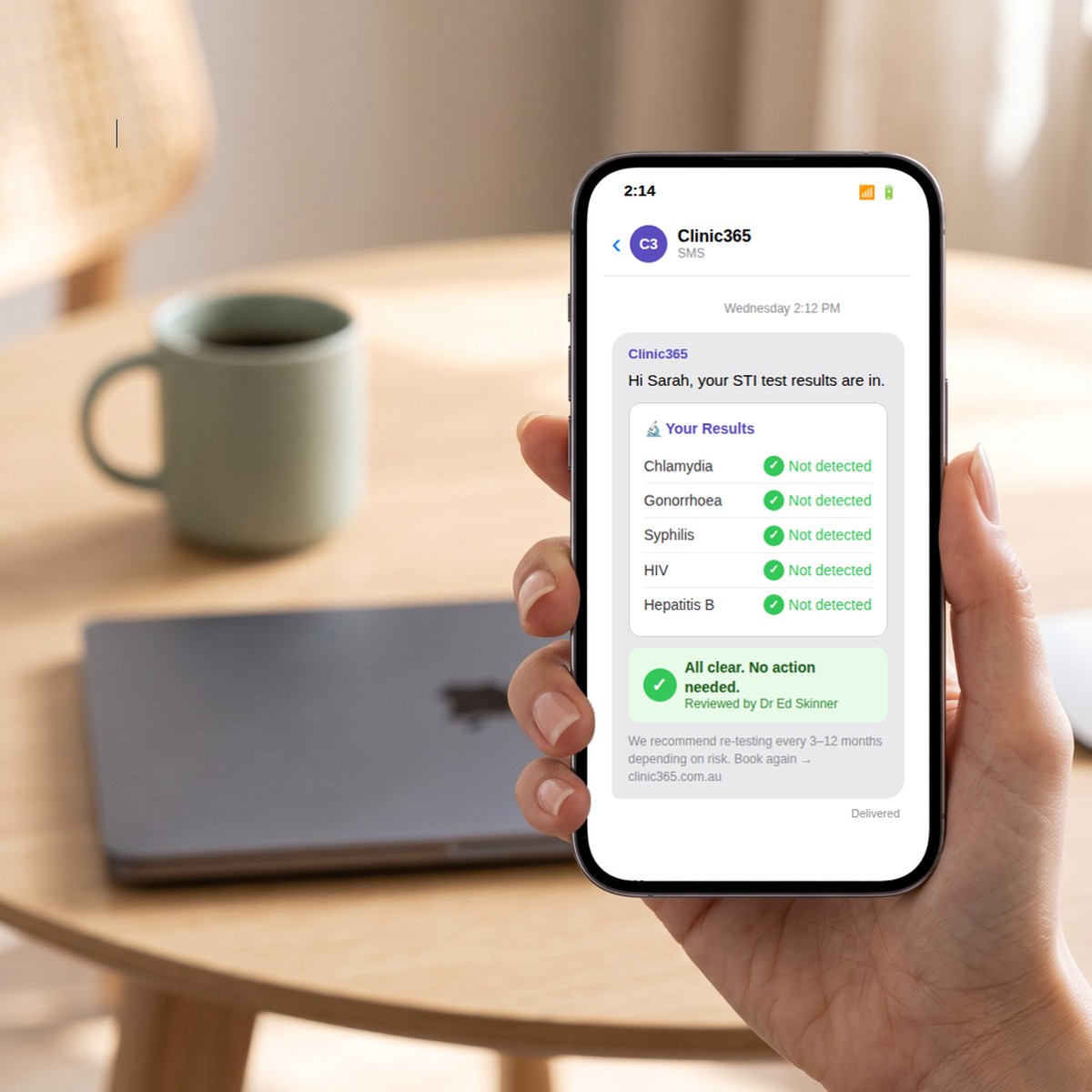
Results by SMS in 2-3 days — telehealth treatment if positive
Book my STI test →

Pathology tests covered by Medicare and most Private Health Insurers.

Dr Ed Skinner — Specialist GP, Founder of Clinic365
Founded by Dr Ed Skinner
Specialist GP · 10+ years sexual health · University of Melbourne
Our story →

STIs and STDs Explained

Sexually transmitted infections (STIs) — also called sexually transmitted diseases (STDs) — are infections passed on through sexual contact, including vaginal, anal and oral sex, and sometimes close skin-to-skin contact. The terms STI and STD mean essentially the same thing; “STI” is the more accurate and now more widely used term, because you can carry an infection without it ever causing disease or symptoms. You’ll see both used interchangeably, and this guide covers testing, treatment and symptoms for the common ones.

STIs are extremely common and nothing to be ashamed of. Some are caused by bacteria and are completely curable; others are caused by viruses and are managed rather than cured. What they overwhelmingly share is that they frequently cause no symptoms at all — which is the single most important thing to understand about them.

STI Symptoms in Men and Women

Most people with an STI have no symptoms. When symptoms do appear, they tend to fall into a handful of patterns: unusual discharge, pain or burning passing urine, sores, blisters, lumps or rashes in the genital area, itching or irritation, unusual bleeding, and pain during sex or in the lower abdomen. Because different STIs cause overlapping symptoms — and because many cause none — symptoms alone can never tell you which infection you have, or even whether you have one. Only testing can.

STI symptoms in men

Many men with an STI notice nothing at all. When symptoms in men do occur, they commonly include:

Symptoms at the throat or rectum (from oral or anal sex) are usually absent, which is why testing those sites when relevant matters. Any new discharge, sore or lump is worth getting checked — but so is testing when you feel completely well, because that’s when most STIs are silently present.

STI symptoms in women

STIs are especially likely to be silent in women, which is part of why untreated infections can quietly cause harm. When symptoms in women do occur, they commonly include:

Because these symptoms overlap with everyday conditions like thrush, bacterial vaginosis and urine infections, and because so many STIs cause no symptoms, testing is the only reliable way to know. Untreated STIs in women can lead to pelvic inflammatory disease, which can affect fertility — a key reason routine testing matters even without symptoms.

When there are no symptoms. It’s worth stating plainly, because it drives everything else: the majority of STIs cause no symptoms, and the person feels perfectly well. Feeling fine is not evidence that you don’t have an STI. This is precisely why regular STI testing exists — it’s the only reliable way to catch infections that usually give no warning, and it’s why testing is recommended for anyone who is sexually active, not just those with symptoms.

Common STIs at a Glance

Here’s how the most common STIs compare — what they can cause, and whether they’re curable or managed. Each links to its own detailed guide covering symptoms, testing and treatment.

STITypeOften silent?Curable?
ChlamydiaBacterialYes — usuallyYes, with antibiotics
GonorrhoeaBacterialOftenYes, with antibiotics
SyphilisBacterialOften (painless sore)Yes, with antibiotics
Mycoplasma genitaliumBacterialOftenYes, but resistance matters
TrichomoniasisParasiteOftenYes, with antibiotics
HerpesViralOftenManaged, not cured
Genital warts (HPV)ViralSometimesManaged; often clears
HIVViralOften early onManaged — treatable and preventable
Hepatitis BViralOftenManaged; vaccine-preventable

STI & STD Testing

STI testing is quick, simple and mostly painless. The samples used depend on what’s being tested and where you may have been exposed:

A standard STI screen for someone without symptoms typically covers chlamydia, gonorrhoea, syphilis and HIV. If you’ve had oral or anal sex, make sure testing includes throat and anal swabs, as a urine sample alone can miss infections at those sites. Results are usually available within a few days.

When and who should get tested?

Consider an STI test if you have any symptoms, if a partner has been diagnosed, after unprotected sex or with a new partner, or simply as part of routine sexual health care. As a general guide, anyone who is sexually active benefits from a yearly check, and more often with new or multiple partners. Because most STIs are silent, testing when you feel well is the main way they’re caught — so routine testing isn’t a sign anything is wrong, it’s simply good sexual health care.

How testing works with Clinic365

A Specialist GP arranges your test over a quick phone call, reviews your symptoms and any exposure, and sends your pathology referral by SMS. You then walk into any pathology lab Australia-wide — no appointment needed — and results come back by SMS, usually in 2-3 days. If anything is found, the Specialist GP calls you to arrange treatment and follow-up. The whole process is by telehealth, so you never need to sit in a waiting room.

STI Treatment, Partners and Prevention

How an STI is treated depends on whether it’s bacterial or viral — a distinction worth understanding:

The key point is that STI treatment is effective and STIs are treatable, and finding one is the start of resolving it — not a catastrophe. Whatever the infection, the sooner it’s found, the simpler it is to treat and the less chance of complications or of passing it on.

Partners and retesting

For most STIs, recent sexual partners need to be tested and treated too, whether or not they have symptoms — this prevents reinfection and stops the infection spreading. Partner notification can be handled confidentially and, where preferred, anonymously. For several STIs, a repeat test a few months after treatment is recommended, because reinfection from an untreated partner is common. Having had an STI gives you no immunity, so you can catch it again on re-exposure.

Preventing STIs

You can reduce your risk of STIs while still having a healthy sex life: condoms reduce the risk of most STIs (though not entirely for those spread by skin contact, like herpes and warts); regular testing for you and partners catches infections early; vaccination protects against hepatitis B and HPV; for HIV, PrEP (before exposure) and PEP (after a possible exposure) are highly effective; and open conversations with partners about testing and sexual health help too.

When to seek urgent care. Seek prompt medical care if you have severe pelvic or lower abdominal pain, fever with genital symptoms, painful swelling of the testicles, difficulty passing urine, or a possible HIV exposure in the last 72 hours (when emergency prevention, PEP, may be an option). These need timely assessment rather than waiting for a routine appointment.

Frequently asked questions

Essentially nothing — they refer to the same thing. “STI” (sexually transmitted infection) is the more accurate and now preferred term, because you can carry an infection without it causing disease or symptoms, whereas “STD” (sexually transmitted disease) is the older term. You’ll see both used interchangeably. Whichever term is used, testing and treatment are the same.
Most people have none. When symptoms appear, common ones include unusual discharge, pain or burning passing urine, sores, blisters, lumps or rashes in the genital area, itching, unusual bleeding, and pain during sex or in the lower abdomen. Because different STIs cause overlapping symptoms — and many cause none — symptoms can’t tell you which infection you have. Only testing can.
Many men have no symptoms. When present, STI symptoms in men include discharge from the penis, burning or pain passing urine, irritation inside the penis, sores or blisters on the penis or around the anus, lumps like genital warts, itching or a rash, and less commonly testicular pain or swelling. A rash on the palms or soles can indicate syphilis. Any new discharge, sore or lump is worth checking.
STIs are especially likely to be silent in women. When present, STI symptoms in women include unusual vaginal discharge, pain passing urine, bleeding between periods or after sex, pain during sex, pelvic pain, sores or blisters, lumps like genital warts, and itching. They overlap with thrush, BV and urine infections, so testing is the only reliable way to know. Untreated STIs can affect fertility.
Yes — this is the norm, not the exception. Most STIs cause no symptoms, and the person feels perfectly well while still being able to pass the infection on. Feeling fine is not evidence you don’t have an STI. This is exactly why regular testing is recommended for anyone sexually active, rather than waiting for symptoms that often never come.
With a combination of a urine sample (for chlamydia and gonorrhoea), swabs (vaginal, throat or anal, often self-collected, plus a swab of any sore), and a blood test (for syphilis, HIV and hepatitis B). A standard screen covers chlamydia, gonorrhoea, syphilis and HIV. If you’ve had oral or anal sex, include throat and anal swabs. Much of it can be done conveniently, including via telehealth.
A standard STI screen for someone without symptoms usually covers chlamydia, gonorrhoea, syphilis and HIV, and often hepatitis B. Herpes and genital warts aren’t part of a routine screen — they’re assessed when there are symptoms. Additional tests, such as for Mycoplasma genitalium or throat and anal swabs, are added based on symptoms and the type of sex you’ve had.
It depends whether they’re bacterial or viral. Bacterial STIs (chlamydia, gonorrhoea, syphilis, Mycoplasma genitalium) and the parasite trichomoniasis are curable with antibiotics — often a short course or single injection. Viral STIs (herpes, HIV, hepatitis B) aren’t cured but are very effectively managed so people live full, healthy lives. Genital warts can be treated and the virus often clears. STIs are treatable.
Many are. Bacterial STIs — chlamydia, gonorrhoea, syphilis, Mycoplasma genitalium — and trichomoniasis are completely curable with antibiotics. Viral STIs like herpes, HIV and hepatitis B can’t be cured but are effectively managed with treatment. So even the ones that aren’t curable are very treatable, and finding an STI is the start of dealing with it, not a catastrophe.
Get tested if you have symptoms, if a partner has been diagnosed, after unprotected sex or with a new partner, or as part of routine care. Anyone sexually active benefits from a yearly check, more often with new or multiple partners. Because most STIs are silent, testing when you feel well is the main way they’re caught — routine testing is simply good sexual health care.
It varies by infection. Chlamydia and gonorrhoea are usually detectable within one to two weeks of exposure; syphilis and HIV can take longer, often several weeks, to show on a blood test. Because of these window periods, testing too soon after a risk can miss an infection, so a clinician may advise when to test or to repeat a test for accuracy.
For most STIs, yes. Recent partners need testing and treatment, whether or not they have symptoms, to prevent reinfection and onward spread. Partner notification can be handled confidentially and, where preferred, anonymously, and a clinic can help. Because reinfection from an untreated partner is common, treating partners is an essential part of clearing many STIs properly.
Condoms reduce the risk of most STIs; regular testing for you and partners catches infections early; vaccination protects against hepatitis B and HPV; and for HIV, PrEP (before exposure) and PEP (after a possible exposure) are highly effective. Open conversations with partners about testing help too. A combination of these gives good protection while still enjoying a healthy sex life.
Seek prompt care for severe pelvic or lower abdominal pain, fever with genital symptoms, painful testicular swelling, difficulty passing urine, or a possible HIV exposure in the last 72 hours — when emergency prevention (PEP) may be an option. These need timely assessment. For everything else, routine testing and treatment are straightforward, confidential and easily arranged.