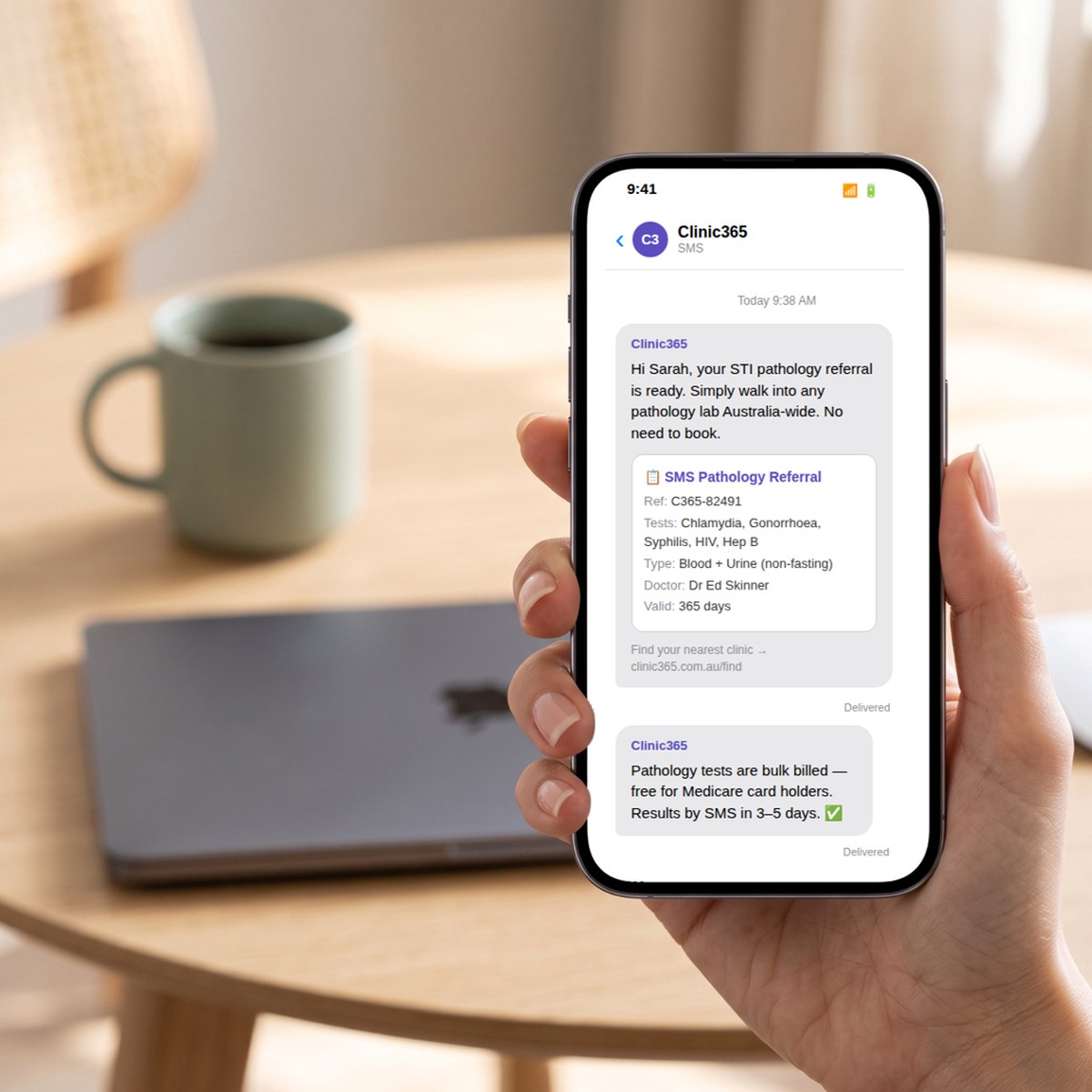
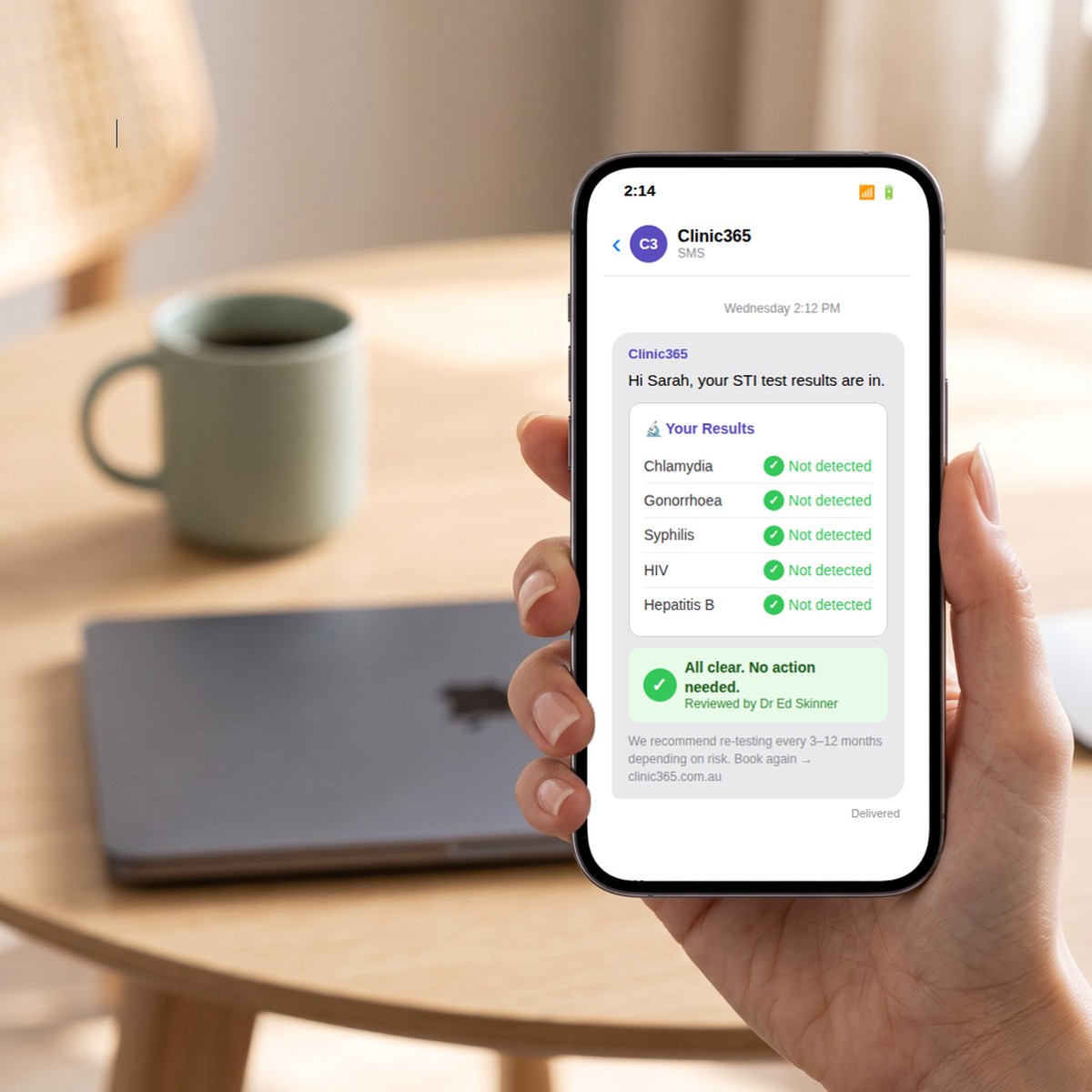
A Specialist GP arranges confidential STI testing in pregnancy — or before you conceive — over a quick phone call. They review what you need, send your pathology referral by SMS, and explain your results. It’s routine, judgement-free care that protects both you and your baby.
A Specialist GP calls you and sends your pathology request by SMS.
📞 “Hi, it’s Clinic365!”
2
Walk in to any lab
Any pathology collection centre, Australia-wide.
📍 Australia-wide
3
Results by SMS
Usually within 2–3 days. If anything needs treatment, we call you.
✅ “Your results are ready”
🧬 Overview
STI Testing in Pregnancy
STI testing in pregnancy means screening for sexually transmitted infections and blood-borne viruses as part of routine antenatal care. It’s offered to every pregnant person in Australia, usually starting at the first antenatal visit, along with the other standard pregnancy blood tests. It isn’t based on any assumption about you or your relationship — it’s simply part of looking after you and your baby well.
The reason it’s universal is straightforward: most STIs cause no symptoms at all, so there’s no way to know you have one without testing. And while an untreated infection can cause real harm to a baby, a treated one usually causes none. Testing is what turns a potentially serious problem into a manageable one. You can also ask for a full STI screen at any time if you’d like one.
❗ Why It Matters
Why It Matters for Your Baby
Some infections can pass to a baby during pregnancy or birth, and the consequences can be serious — including miscarriage, stillbirth, premature birth, low birth weight, and infections in the newborn. That sounds frightening, but the crucial point is the flip side:
The reassuring part
These outcomes are largely preventable. When infections are found and treated in pregnancy, the great majority of babies are born healthy and unaffected.
Treatment works, and it works best early — which is exactly why testing happens early and, for some infections, more than once.
There are proven steps at birth for some infections that protect the baby even further.
In other words, testing isn’t about finding something to worry about. It’s about making sure that if something is there, it’s dealt with in time — which almost always means a healthy baby.
📋 Which Test
Which Infections Are Tested — and When
Routine antenatal screening in Australia generally includes tests for:
Can cause miscarriage, stillbirth, premature birth and serious illness in the baby — but is very effectively prevented by treatment. Now tested several times in pregnancy.
HIV
With treatment in pregnancy, the risk of passing HIV to the baby becomes extremely low. Without it, the risk is far higher.
Hepatitis B
Can pass to the baby at birth, but vaccination and protective treatment given to the newborn prevent this very effectively.
Hepatitis C
Testing is now recommended in pregnancy so it can be monitored, and treated after the birth.
Recommended particularly for younger pregnant people; linked to premature birth and eye or chest infections in the newborn. Easily treated.
Other tests, such as checking immunity to rubella, are also part of standard antenatal screening. Your care provider may recommend additional tests depending on your circumstances — and you can always ask for a full sexual health check if you’d like one.
When testing happens
Most STI screening is done at the first antenatal visit, as part of the initial round of pregnancy blood tests — ideally early in the pregnancy, so there’s plenty of time to treat anything found. Some tests are then repeated later in the pregnancy, because it’s possible to acquire an infection after that first test. The most important example is syphilis, which is now tested more than once in every pregnancy (see below). Testing may also be repeated at any point if you have symptoms, a change of partner, or a known exposure — and it’s never too late to be tested, even if you’ve presented late for antenatal care.
🧬 Syphilis
The New Syphilis Retesting — an Important Change
Australia has seen a re-emergence of congenital syphilis (syphilis passed from mother to baby), which can cause stillbirth, prematurity and serious illness in newborns. In response, national guidance changed: instead of a single test at the first visit for most people, syphilis testing is now recommended at least three times in every pregnancy, regardless of risk:
Syphilis testing schedule in pregnancy
At the first antenatal visit
At around 26–28 weeks
At around 36 weeks, or at birth (whichever comes first)
This applies to everyone, not just people considered at higher risk — because risk-based testing was missing cases. Extra tests may also be done if you have symptoms of any STI or a known exposure. It might feel like a lot of testing, but the reasoning is simple: congenital syphilis is almost entirely preventable when the infection is found and treated in time, and repeat testing is what catches an infection acquired later in the pregnancy.
Is this routine, or am I being singled out?
It’s completely routine. Everyone is offered these tests, in every pregnancy, whatever their age, relationship or circumstances — it’s not a judgement, a suspicion, or a comment on you or your partner. Health services test universally precisely because targeting only people who “seem at risk” misses infections and puts babies at risk. Anyone can have an STI — many are symptomless and can be carried for years without knowing, and it’s possible to acquire one at any time, including during a pregnancy. Finding one says nothing about you as a person or a parent — it just means it can now be treated. Your care is confidential, and your team’s only concern is a healthy pregnancy.
🩺 Testing
What the Tests Involve — and If One Is Positive
Most STI screening in pregnancy is done with a simple blood test — syphilis, HIV, hepatitis B and hepatitis C are all checked from blood, usually taken at the same time as your other routine antenatal bloods, so it’s typically just one needle. Chlamydia and gonorrhoea are checked with a urine sample or a swab, and the swab can usually be self-collected in private if you’d prefer. Nothing is uncomfortable, and none of these tests pose any risk to your pregnancy or your baby.
If a test comes back positive
First: a positive result is not a disaster, and it’s not a reason to panic. It means the infection has been found at a point where something can be done about it — which is the entire purpose of testing. What happens next depends on the infection, but generally:
Your result is confirmed, and you’ll have a conversation with your doctor or midwife about what it means.
Treatment is started promptly, using options that are suitable in pregnancy.
You may be referred to a specialist service for extra support and monitoring.
Your partner(s) will need testing and treatment too.
Your baby may have some checks after birth, and for some infections, protective treatment straight after delivery.
Care is confidential and supportive throughout. Many people are diagnosed with an STI in pregnancy each year, are treated, and go on to have completely healthy babies.
💊 Treatment
Treatment in Pregnancy — and Partners
Effective treatments exist for STIs in pregnancy, and suitable options are chosen specifically for use while pregnant — your care team won’t give you anything that isn’t appropriate for your pregnancy. Bacterial infections like chlamydia, gonorrhoea and syphilis are cured with antibiotics. For syphilis in particular, a specific antibiotic injection is the only treatment proven to protect the baby as well as the mother, so if you have any antibiotic allergy it’s very important to mention it, as this needs special management rather than simply switching treatment.
Viral infections such as HIV and hepatitis B aren’t cured, but are very effectively managed: treatment in pregnancy plus steps taken at birth reduce the chance of passing them to the baby to very low levels. Hepatitis C is generally treated after pregnancy. In all cases, the earlier treatment starts, the better the protection — another reason not to delay testing.
Partners and avoiding reinfection
If you’re diagnosed with an STI in pregnancy, your partner needs testing and treatment as well — even if they have no symptoms. This isn’t just fairness: if a partner is untreated, you can be reinfected, and an infection acquired later in pregnancy can be the most dangerous of all for the baby. Partner notification can be handled confidentially and, if you prefer, anonymously, and your clinic can help you with how to approach it. Avoiding sex until you and your partner have both completed treatment (as advised) is an important part of keeping the pregnancy protected.
⚠️ Symptoms
Symptoms Not to Ignore — and When to See a Doctor
Don’t wait for your next scheduled test if you notice unusual vaginal discharge, sores, ulcers, blisters or lumps in the genital area, pain passing urine, pelvic or lower abdominal pain, itching or a rash — including a rash on the palms or soles, which can be a sign of syphilis. Also speak up promptly if a partner is diagnosed with an STI, or you think you may have been exposed. These are all reasons to be tested straight away rather than waiting.
See your doctor or midwife if you have any of the symptoms above, if a partner has been diagnosed with an STI, if you’re worried about a possible exposure, or if you’re pregnant and haven’t yet had your antenatal screening tests. It’s also worth asking about testing if you’re planning a pregnancy — a sexual health check before conceiving means anything found can be treated in advance.
If you’d like confidential STI testing in pregnancy, before pregnancy, or advice about a result, Clinic365 makes it easy — book online and speak with a Specialist GP by phone. Care is confidential and judgement-free.
Ready when you are. A Specialist GP can arrange everything by phone, with your referral sent straight to your phone by SMS.
Because most STIs cause no symptoms, so there’s no way to know you have one without testing — and some infections can pass to a baby and cause serious harm, including miscarriage, stillbirth, premature birth or newborn infection. When found and treated in pregnancy, the great majority of babies are born healthy. Testing turns a potentially serious problem into a manageable one, which is why it’s offered to everyone.
Which STIs are tested for in pregnancy?
Routine antenatal screening in Australia generally includes syphilis, HIV, hepatitis B and hepatitis C, with chlamydia (and often gonorrhoea) recommended particularly for younger pregnant people. Other standard tests, such as checking rubella immunity, are also part of antenatal care. Your provider may recommend additional tests depending on your circumstances, and you can always ask for a full sexual health check if you’d like one.
When are STI tests done in pregnancy?
Most screening happens at the first antenatal visit, with the initial round of pregnancy blood tests, ideally early so there’s time to treat anything found. Some tests are repeated later, since infections can be acquired after that first test — syphilis is now tested more than once in every pregnancy. Testing can also be repeated any time you have symptoms, a change of partner, or a known exposure.
How many times is syphilis tested in pregnancy?
National guidance now recommends syphilis testing at least three times in every pregnancy, regardless of risk: at the first antenatal visit, at around 26 to 28 weeks, and at around 36 weeks or at birth (whichever comes first). This replaced the older approach of a single test for most people, because risk-based testing was missing cases. Extra tests may be done if you have symptoms or a known exposure.
Why has syphilis testing in pregnancy changed?
Australia has seen a re-emergence of congenital syphilis — syphilis passed from mother to baby — which can cause stillbirth, prematurity and serious newborn illness. Because testing only those thought to be at risk was missing infections, guidance changed to universal repeat testing for everyone. Congenital syphilis is almost entirely preventable when the infection is found and treated in time, and repeat testing catches infections acquired later in pregnancy.
Am I being singled out or judged by these tests?
No — it’s completely routine. Everyone is offered these tests, in every pregnancy, whatever their age, relationship or circumstances. Health services test universally precisely because targeting only people who seem at risk misses infections and puts babies at risk. Anyone can have an STI, many are symptomless for years, and finding one says nothing about you as a person or a parent.
What do the tests involve?
Most STI screening in pregnancy is a simple blood test — syphilis, HIV, hepatitis B and hepatitis C are all checked from blood, usually taken at the same time as your other routine antenatal bloods, so it’s typically just one needle. Chlamydia and gonorrhoea are checked with a urine sample or a swab, which can usually be self-collected in private. None of these tests pose any risk to your pregnancy or baby.
What happens if a test is positive?
A positive result isn’t a disaster — it means the infection was found while something can be done about it. Your result is confirmed, you’ll discuss what it means with your doctor or midwife, treatment suitable in pregnancy is started promptly, you may be referred for specialist support, your partner will need testing and treatment, and your baby may have checks or protective treatment after birth. Care is confidential and supportive throughout.
Is STI treatment safe during pregnancy?
Yes — suitable options are chosen specifically for use in pregnancy, and your care team won’t give you anything inappropriate for your pregnancy. Bacterial infections like chlamydia, gonorrhoea and syphilis are cured with antibiotics. Viral infections like HIV and hepatitis B aren’t cured but are very effectively managed with treatment plus steps at birth. The earlier treatment starts, the better the protection for your baby.
Can an STI harm my baby if it’s treated?
Usually not. The serious outcomes associated with STIs in pregnancy are largely linked to infections that go undetected and untreated. When an infection is found and treated in time, the great majority of babies are born healthy and unaffected, and for some infections there are proven steps at birth that protect the baby further. This is exactly why testing early — and repeating it — matters so much.
Does my partner need testing too?
Yes. If you’re diagnosed with an STI in pregnancy, your partner needs testing and treatment even without symptoms — otherwise you can be reinfected, and an infection acquired later in pregnancy can be the most dangerous for the baby. Partner notification can be handled confidentially and, if you prefer, anonymously, and your clinic can help. Avoiding sex until you’ve both completed treatment as advised protects the pregnancy.
What symptoms should I not ignore while pregnant?
Don’t wait for your next scheduled test if you notice unusual vaginal discharge, sores, ulcers, blisters or lumps in the genital area, pain passing urine, pelvic or lower abdominal pain, itching, or a rash — including on the palms or soles, which can indicate syphilis. Also speak up promptly if a partner is diagnosed with an STI or you think you may have been exposed. These warrant testing straight away.
Should I get tested before trying to conceive?
It’s a good idea. A sexual health check before pregnancy means anything found can be treated in advance, so you start the pregnancy clear — and it’s one less thing to organise later. It’s also a good time to check your rubella immunity and discuss vaccinations with your doctor. If you’re planning a pregnancy, ask about a pre-conception sexual health check alongside your other preparations.