At-home STI testing explained: rapid tests vs lab-based kits
There are two kinds of at-home STI test in Australia: instant rapid tests and lab-based home collection. Here is how they differ on accuracy, scope and what you can do with the result.

At-home STI testing now comes in two very different forms, and the difference matters. One is an instant rapid test you do entirely yourself; the other is a lab-based home kit, where you collect your own sample and a laboratory does the testing. Clinic365 uses the lab-based approach — here's why, with an honest look at what each can and can't do.
The two kinds of at-home STI test
Since late 2024, both are available in Australia:3
- Instant rapid self-tests. Sold in pharmacies, these work like a COVID rapid test: you take a vaginal swab, mix it with the solutions provided, and read the result on a cassette in about 15 minutes.
- Lab-based home collection. You collect your own urine sample at home and drop it to any pathology lab the same day, where it's tested using the same method a clinic would use. This is what Clinic365's at-home STI test kit uses.
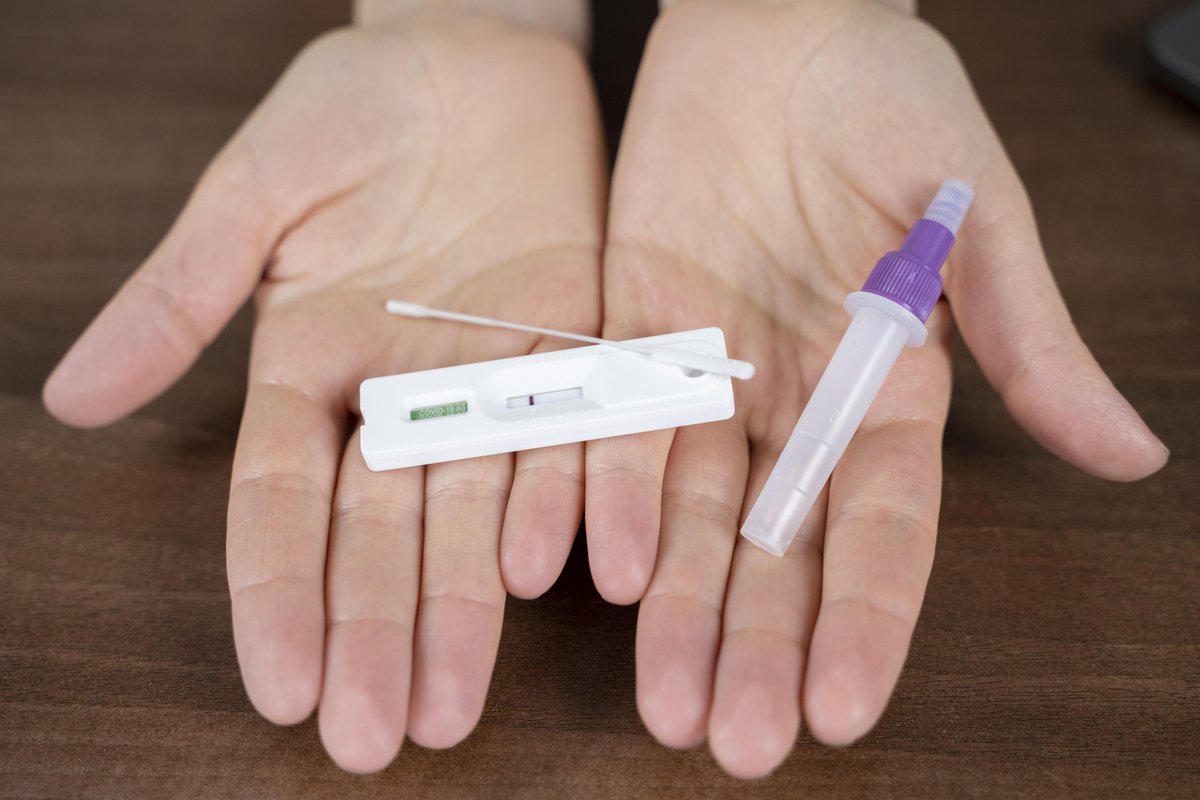
Instant rapid self-tests: fast, but with trade-offs
The appeal is obvious — a private result in minutes, no consult, no lab. But there are real limits worth knowing:
- They test for two infections only, chlamydia and gonorrhoea, and use a vaginal swab — so they aren't an option for everyone, or for a full screen.
- A positive result still has to be confirmed with a lab test before treatment.3
- Accuracy claims vary. Australia's Therapeutic Goods Administration requires an approved at-home STI test to detect at least 95% of true infections;2 higher figures quoted by manufacturers aren't always backed by peer-reviewed evidence. Even at that standard, a small number of infections can be missed.
- You interpret and act on the result alone — there's no GP to work out what else you should test for, or to treat you if it's positive.
Lab-based home collection: home convenience, lab accuracy
This is the approach Clinic365 uses. You do the easy part — collecting a urine sample at home — and the laboratory does the testing, using nucleic acid amplification testing (NAAT), the reference-standard method for chlamydia and gonorrhoea.1 For detecting these infections, a self-collected urine sample is as accurate as one taken at a clinic.
What that gets you:
- A urine sample you collect at home, then drop to any pathology lab the same day — Australia-wide, no posting and no reply-paid wait.
- A full screen when you need it. If blood tests are required (for HIV or syphilis, for example), a referral is sent so the bloods can be taken when you drop your urine sample off.
- A Specialist GP involved from the start, who tailors the tests and treats you if anything is positive.
- Results by SMS, usually within 3 to 5 days.
- Free for Medicare card holders.
Which is more accurate?
For confirming whether you have chlamydia or gonorrhoea, lab-based NAAT is the benchmark every other test is measured against.14 Instant rapid tests are improving, but they're built for speed and convenience rather than to replace a lab — which is exactly why a positive rapid result still needs a lab test to confirm it. If you want a result you can act on straight away, lab-based testing avoids that second step.
What Clinic365's at-home kit covers
It works like this: you collect a urine sample at home, then drop it to any pathology collection centre the same day — there's no posting and no waiting on the mail, and it works Australia-wide. If you also need blood tests, a referral is ready so those can be taken at the same visit. Your results are reviewed by a Specialist GP, with treatment arranged if you need it. If cervical screening is what you're after, that has its own self-collection kit too.
Which should you choose?
- An instant rapid test if you specifically want a chlamydia or gonorrhoea result in minutes and are willing to confirm a positive with a lab afterwards.
- Lab-based home collection if you want a full screen, lab-grade accuracy, and a doctor who can treat you if needed — without a second step.
Either way, testing beats not testing. Most STIs have no symptoms, so a check is the only way to know.
At-home STI testing FAQs
Are at-home STI tests accurate?
It depends on the type. Lab-based home collection uses NAAT, the same reference-standard method as a clinic, so it's highly accurate. Instant rapid tests must meet a minimum standard to be approved in Australia, but a positive result still needs lab confirmation.
Do I need a lab test if my rapid test is positive?
Yes. A positive instant rapid test should always be confirmed with a laboratory test before treatment.
Does Clinic365 use a rapid test or a lab test?
Lab-based. Your self-collected sample is tested by a laboratory and reviewed by a Specialist GP, so there's no second confirmation step.
References
- Australian STI Management Guidelines for Use in Primary Care. Chlamydia (testing with NAAT). sti.guidelines.org.au
- Therapeutic Goods Administration. Understanding the rules for in-vitro diagnostic (IVD) self-tests for chlamydia, gonorrhoea and syphilis. 2024. tga.gov.au
- UNSW Sydney. A new at-home test will soon be available for chlamydia and gonorrhoea: here's what to know. December 2024. unsw.edu.au
- Point-of-care tests for Chlamydia trachomatis and Neisseria gonorrhoeae: review of the literature. Clinical Infectious Diseases. academic.oup.com
This article is general information only and is not a substitute for personal medical advice. It was written and clinically reviewed by Dr Edward (Ed) Skinner (MBBS, FRACGP; AHPRA MED0001674680) and last reviewed on September 2026.