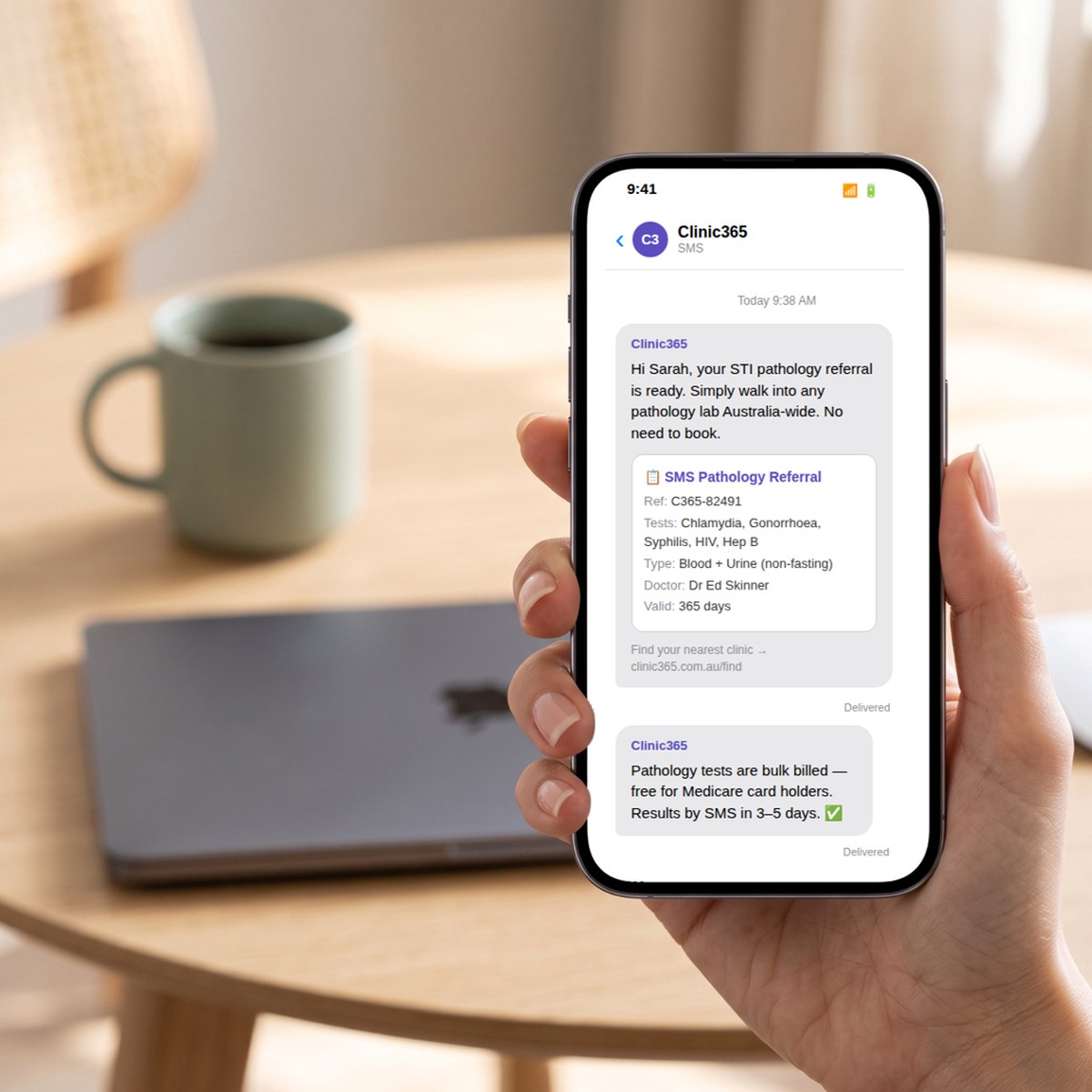
A Specialist GP arranges your test over a quick phone call — they review your symptoms and exposure, then send your pathology referral by SMS. Gonorrhoea is often symptomless, so testing the right site matters.
A Specialist GP calls you and sends your pathology request by SMS.
📞 “Hi, it’s Clinic365!”
2
Walk in to any lab
Any pathology collection centre, Australia-wide.
📍 Australia-wide
3
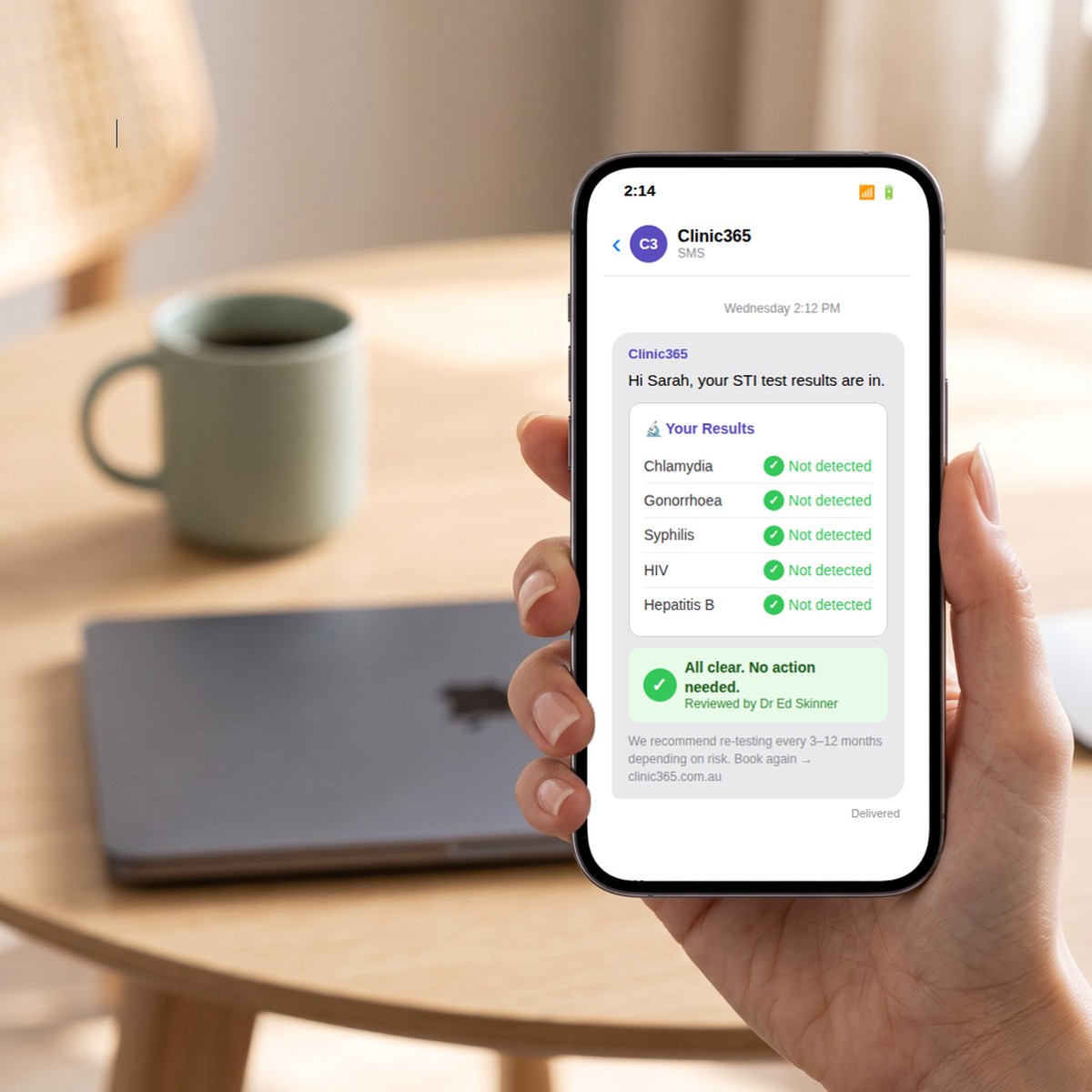
Results by SMS
Usually within 2–3 days. If anything needs treatment, we call you.
✅ “Your results are ready”
🧬 Overview
What Is Gonorrhoea?
Gonorrhoea (also spelt gonorrhea) is a common sexually transmitted infection caused by a bacterium. It’s spread through vaginal, anal and oral sex, and it can infect the genitals, the rectum, the throat and, less commonly, the eyes. It’s one of the most frequently diagnosed STIs, and rates have been rising — but because it so often causes no symptoms, many infections go unnoticed and are passed on unknowingly.
The good news is that gonorrhoea is straightforward to test for and, in most cases, cured with treatment. The catch is that it’s increasingly resistant to antibiotics, so it needs to be treated properly rather than casually — more on that below.
⚠️ Symptoms
Gonorrhoea Symptoms in Men and Women
Gonorrhoea frequently causes no symptoms, particularly in women and at the throat and rectum. When symptoms do occur, they usually come from inflammation at the site of infection and appear within about two to ten days. Because they overlap with other STIs such as chlamydia, symptoms alone can’t tell you which infection you have — only a test can.
Gonorrhoea symptoms in men
Gonorrhoea in men is more likely to be noticed than in women, though many men still have no symptoms. Symptoms can include:
Discharge from the penis, often thick and yellow, white or greenish
Burning or pain when passing urine
Irritation or discomfort inside the penis
Pain or swelling in the testicles (less common, and a reason to seek care promptly)
Gonorrhoea symptoms in women
Gonorrhoea in women is often silent, which is exactly why it can go untreated and cause problems. When symptoms do appear, they can include:
Unusual vaginal discharge
Pain or burning when passing urine
Bleeding between periods or after sex
Lower abdominal or pelvic pain
Pain during sex
Because these symptoms are mild or absent so often, women may not know they have gonorrhoea until it causes complications such as pelvic inflammatory disease — another reason routine testing matters even when you feel well.
Throat and rectal gonorrhoea
Gonorrhoea can also infect the throat (from oral sex) and the rectum (from anal sex), and infections at these sites are very often symptom-free. Occasionally throat infection causes a mild sore throat, and rectal infection can cause discomfort, discharge or itching, but usually there’s nothing to notice at all.
Sample sites matter. If you’ve had oral or anal sex, testing only a urine sample can miss throat and rectal gonorrhoea entirely. Make sure your testing includes throat and anal swabs where relevant — these infections won’t be found unless they’re specifically looked for, and they’re where antibiotic-resistant gonorrhoea is most likely to develop.
Often there are no symptoms
A large proportion of gonorrhoea infections cause no symptoms whatsoever, and the person feels completely well. This is how the infection spreads so effectively, and it’s the single best argument for routine STI testing. Feeling fine is not evidence you don’t have gonorrhoea — only a test can tell you.
🩺 Testing
Gonorrhoea Testing
Testing for gonorrhoea is quick and simple, using samples matched to where you may have been exposed:
A first-catch urine sample — commonly used to test for genital gonorrhoea.
Swabs — a vaginal swab (often self-collected), and throat and anal swabs where relevant, which can also often be self-collected.
The samples are analysed with a sensitive molecular test (NAAT/PCR) that detects the bacterium’s genetic material, and gonorrhoea is included in standard STI screens alongside chlamydia, syphilis and HIV. If gonorrhoea is found, a further laboratory test (a culture) is sometimes done to check which antibiotics will work, given resistance. Gonorrhoea is usually detectable from about two weeks after exposure.
When should you get tested?
Consider a gonorrhoea test if you have any symptoms, if a partner has been diagnosed, after unprotected sex or a new partner, or simply as part of routine STI screening if you’re sexually active. Because gonorrhoea is so often silent, testing when you feel well is the main way it’s caught. As a general guide, a yearly STI check is sensible, and more often with new or multiple partners.
How testing works with Clinic365
A Specialist GP arranges your test over a quick phone call, reviews your symptoms and exposure so the right sites are covered, and sends your pathology referral by SMS. You then walk into any pathology lab Australia-wide — no appointment needed — and results come back by SMS, usually in 2-5 days. If gonorrhoea is found, the Specialist GP calls you and arranges treatment. You can also screen for other infections at the same time with the full STI test, since gonorrhoea often occurs alongside chlamydia.
💊 Treatment
Gonorrhoea Treatment and Antibiotic Resistance
Gonorrhoea is treated with an antibiotic injection, usually given as a single dose, and it’s highly effective when the right treatment is used. Because of antibiotic resistance, treatment is given as an injection rather than tablets alone, and it’s important this is done by a clinician rather than with leftover or online-bought antibiotics, which may not work and worsen resistance. Avoid sex for about a week after treatment and until any partners have been treated, and attend any retest that’s arranged. Symptoms usually settle within a few days; if they don’t, go back to your clinician.
Antibiotic resistance
Gonorrhoea has become increasingly resistant to antibiotics over the years, to the point where it’s considered a significant public health concern. This is why current treatment relies on an injection, why leftover or unsupervised antibiotics are strongly discouraged, and why a follow-up test is sometimes recommended to confirm the infection has cleared. Treating gonorrhoea properly, first time, protects both you and the effectiveness of the antibiotics that still work.
Partners and retesting
Recent sexual partners need to be tested and treated, whether or not they have symptoms, to prevent reinfection and onward spread. Partner notification can be handled confidentially and, where preferred, anonymously. Because reinfection is common, a repeat test around three months after treatment is often recommended, even if you feel completely well.
❗ Why It Matters
Why Treating Gonorrhoea Matters
Treating gonorrhoea matters beyond clearing symptoms. Untreated, it can cause pelvic inflammatory disease and affect fertility in women, inflammation of the testicles (epididymitis) in men, and — rarely — spread to the bloodstream and joints. It also increases the risk of acquiring and transmitting HIV. Against all of that, treatment is quick and effective, which is why finding gonorrhoea early is worthwhile — and testing is how it’s found.
Seek prompt care if you have severe pelvic or lower abdominal pain, fever, painful testicular swelling, or a red, painful eye with discharge — these can indicate complications that need urgent assessment rather than waiting for a routine appointment.
Ready when you are. A Specialist GP can arrange everything by phone, with your referral sent straight to your phone by SMS.
Gonorrhoea is a common sexually transmitted infection caused by a bacterium, spread through vaginal, anal and oral sex. It can infect the genitals, rectum, throat and, less commonly, the eyes. It’s one of the most frequently diagnosed STIs and rates are rising, but because it so often causes no symptoms, many infections go unnoticed and are passed on unknowingly.
What are the symptoms of gonorrhoea?
Gonorrhoea frequently causes no symptoms, especially in women and at the throat and rectum. When present, symptoms come from inflammation at the site of infection, appearing within about two to ten days. In men: discharge and pain passing urine. In women: unusual discharge, pain passing urine, bleeding between periods, and pelvic pain. They overlap with chlamydia, so testing is what identifies it.
What are gonorrhoea symptoms in men?
Men are more likely to notice symptoms, though many still don’t. Symptoms in men can include discharge from the penis (often thick and yellow, white or greenish), burning or pain when passing urine, irritation inside the penis, and less commonly pain or swelling in the testicles — which is a reason to seek care promptly. Throat and rectal infections are usually symptom-free.
What are gonorrhoea symptoms in women?
In women gonorrhoea is often silent. When symptoms appear, they can include unusual vaginal discharge, pain or burning passing urine, bleeding between periods or after sex, lower abdominal or pelvic pain, and pain during sex. Because it’s so often mild or absent, women may not know they have it until it causes complications such as pelvic inflammatory disease, which is why routine testing matters.
Can gonorrhoea affect the throat or rectum?
Yes. Gonorrhoea can infect the throat (from oral sex) and the rectum (from anal sex), and these infections are very often symptom-free. This is why sample sites matter: testing only urine can miss throat and rectal gonorrhoea. If you’ve had oral or anal sex, make sure your testing includes throat and anal swabs, which can often be self-collected.
How is gonorrhoea tested for?
Testing uses a first-catch urine sample for genital gonorrhoea, plus swabs — a vaginal swab (often self-collected), and throat and anal swabs where relevant. Samples are analysed with a sensitive molecular test (NAAT/PCR). Gonorrhoea is included in standard STI screens. Results usually take 2-5 days, and a further culture test is sometimes done to check antibiotic sensitivity.
When should I get tested for gonorrhoea?
Get tested if you have symptoms, if a partner has been diagnosed, after unprotected sex or a new partner, or as part of routine screening if you’re sexually active. Because gonorrhoea is often silent, testing when you feel well is the main way it’s caught. A yearly check is sensible, more often with new or multiple partners. It’s usually detectable from about two weeks after exposure.
How is gonorrhoea treated?
Gonorrhoea is treated with an antibiotic injection, usually a single dose, and it’s highly effective with the right treatment. Because of resistance, it’s given as an injection rather than tablets alone, and must be done by a clinician rather than with leftover or online-bought antibiotics. Avoid sex for about a week after treatment and until partners are treated.
Is gonorrhoea curable?
Yes, gonorrhoea is curable with the correct antibiotic treatment, usually a single injection. The important caveat is antibiotic resistance, which is why treatment must be given properly by a clinician and why a follow-up test is sometimes recommended to confirm it’s cleared. Treated correctly and early, gonorrhoea resolves and complications are avoided.
Why is antibiotic resistance a concern with gonorrhoea?
Gonorrhoea has become increasingly resistant to antibiotics, to the point of being a significant public health concern. This is why treatment now relies on an injection, why unsupervised or leftover antibiotics are strongly discouraged, and why a follow-up test is sometimes advised. Treating it properly first time protects you and preserves the antibiotics that still work.
Does my partner need treatment?
Yes. Recent partners need to be tested and treated, whether or not they have symptoms, to prevent reinfection and onward spread. Partner notification can be handled confidentially and, where preferred, anonymously, and a clinic can help you with how to approach it. Treating partners is essential to clearing gonorrhoea properly and avoiding a repeat.
Do I need to be retested after treatment?
Often, yes. A repeat test around three months after treatment is commonly recommended because reinfection is common, and a follow-up test to confirm the infection cleared is sometimes advised given antibiotic resistance. Your clinician will let you know what’s recommended for you and when. Retesting is worthwhile even if you feel completely well.
What happens if gonorrhoea is left untreated?
Untreated gonorrhoea can cause pelvic inflammatory disease and affect fertility in women, inflammation of the testicles in men, and rarely spread to the bloodstream and joints. It also increases the risk of acquiring and transmitting HIV. Because treatment is quick and effective, there’s no reason to leave it untreated once it’s found — and testing is how it’s found.