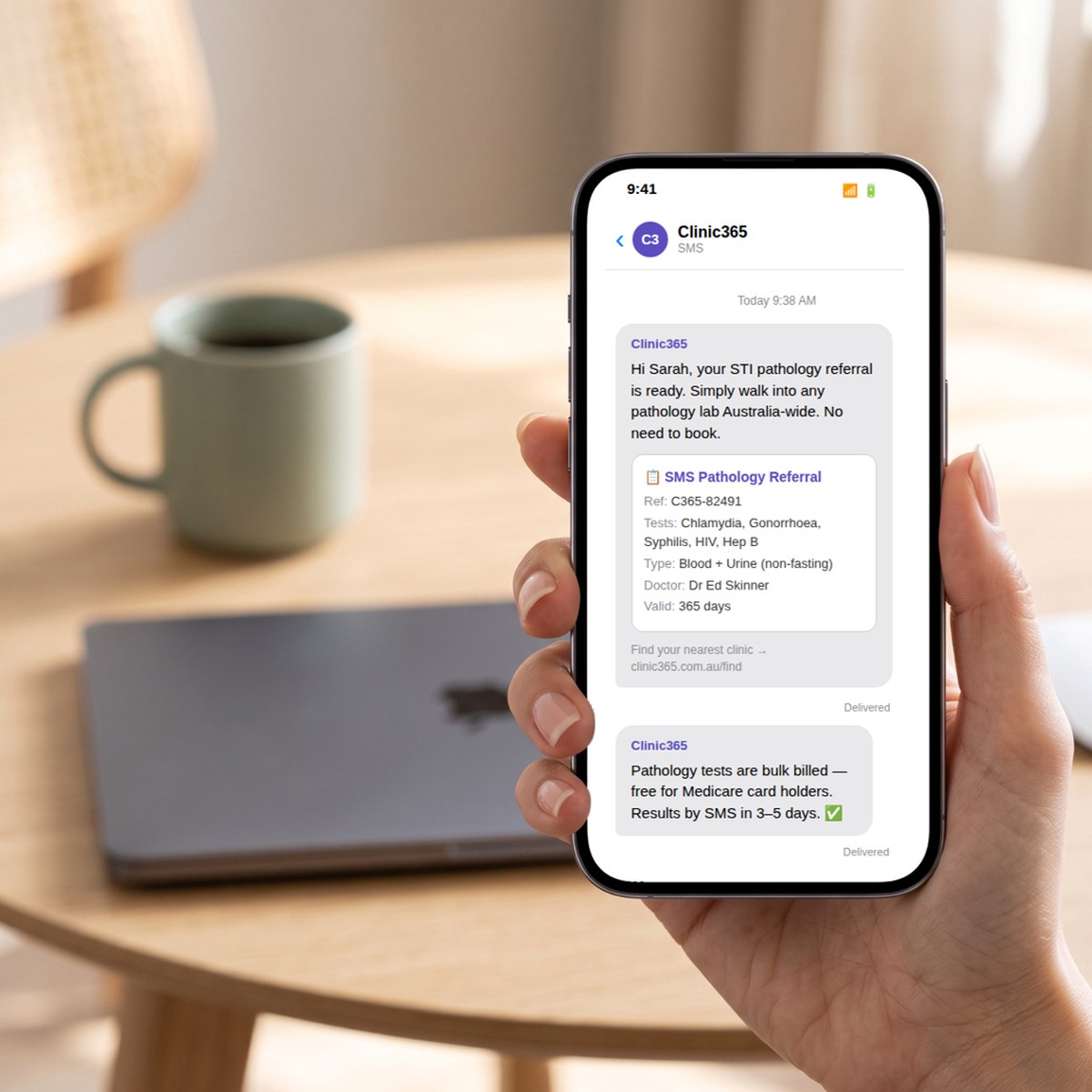
A Specialist GP arranges your test over a quick phone call — they review your symptoms and risk, then send your pathology referral by SMS — a full STI screen covering chlamydia, gonorrhoea, syphilis, HIV and hepatitis B.
Book a telehealth consult — free with Medicare (*bulk-billed)
Get tested at any pathology lab in Perth or regional WA — simply walk in
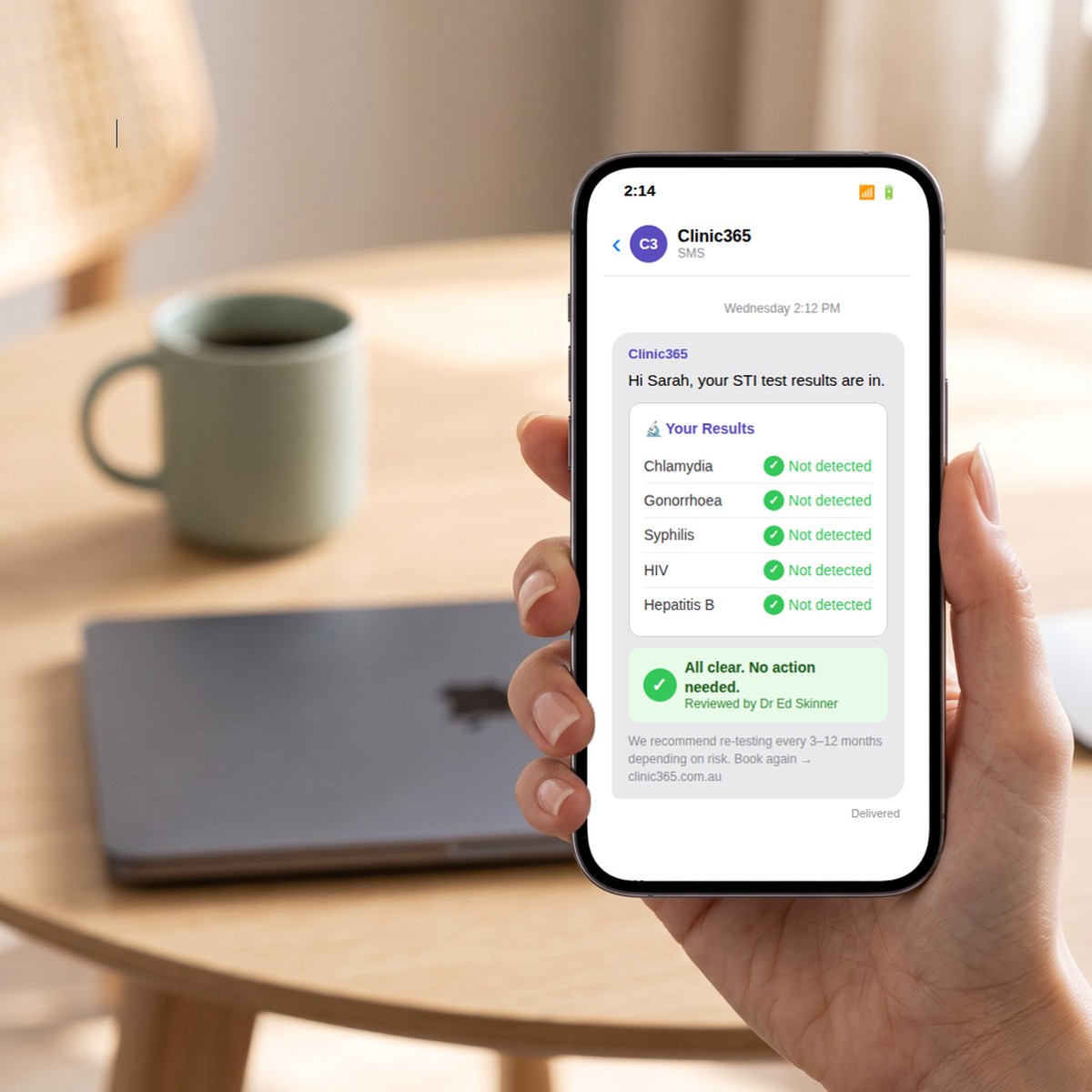
Results by SMS in 3-5 days — telehealth treatment if positive
Your pathology referral arrives by SMS — then simply walk into any pathology lab in Perth to get tested.
Australian Clinical Labs and other major pathology networks run collection centres across Perth and the surrounding region. Find your nearest on the map above.
🏥 Your Local Clinic
Sexual Health Clinic & STI Testing in Perth
Have symptoms or a recent risk? If you have any symptoms — discharge, sores, pain, unusual bleeding, or a rash — or a partner has tested positive, mention it when you book your telehealth consult so the Specialist GP can take a history, choose the right tests, and arrange treatment if you need it.
Testing too soon after sex can miss an infection. Each test has a window period before it turns positive: chlamydia and gonorrhoea about 2 weeks, syphilis up to 6 weeks, HIV 4 to 6 weeks, and hepatitis B from 6 weeks.
The standard screen covers five infections. A routine screen tests for chlamydia, gonorrhoea, syphilis, HIV, and hepatitis B from one blood test and a urine sample. Optional add-ons: herpes, Mgen, trichomonas, BV, and thrush. If you have had oral or anal sex, add a throat or anal swab — a urine sample alone misses throat and rectal infections.
Pathology coverage across a spread-out city and regional WA. Perth runs 75 km from Mandurah to Joondalup, one of Australia's most spread-out cities. Collection centres cluster in the CBD and inner suburbs, the western suburbs (Claremont, Cottesloe, Nedlands), and the south (Applecross, Fremantle), reaching out to Joondalup, Midland, Rockingham, and Mandurah. The referral also works across regional WA — South West, Wheatbelt, Goldfields, Pilbara, and Kimberley — and at Aboriginal community-controlled health services where available. WA recorded over 12,000 chlamydia and 4,500 gonorrhoea notifications in 2023, with much higher rates in remote communities; the Kimberley and Pilbara remain priority areas in the national syphilis response. PrEP and DoxyPEP are available through Australia-wide telehealth pathways.
If a result is positive, treatment is arranged on the same call. A Specialist GP calls you to talk it through and arranges treatment. Partner notification is supported via the Let Them Know SMS tool. Chlamydia, gonorrhoea, syphilis, and HIV are reported to WA Health for surveillance; this is handled for you and does not appear on your personal records.
A possible HIV exposure is urgent. HIV post-exposure prevention (PEP) must start within 72 hours of exposure to work. Our Emergency PEP service can arrange same-day treatment and a pathology referral within hours; Royal Perth Hospital and Sir Charles Gairdner Hospital emergency departments can also provide PEP outside business hours.
How often should you test? If you are sexually active, a yearly STI screen is a sensible baseline. Test more often — around every three months — if you have new or multiple partners, after a condom breaks, or if a partner tests positive. And test whenever symptoms appear, whatever your last result was.
Clinic365 is an online sexual health clinic serving Perth by telehealth — your consult is by phone with a Specialist GP and your testing is done at a Perth pathology lab. There is no walk-in Clinic365 premises in Perth; everything except giving the sample is handled remotely.
Walk into any pathology clinic across Perth with your Clinic365 SMS referral — CBD, Northbridge, Mount Lawley, Subiaco, Leederville, Claremont, Cottesloe, Fremantle, South Perth, Joondalup, Midland, Armadale, Rockingham, and Mandurah. No appointment needed at most locations. Most are open Monday to Saturday in metro areas.
Yes. The major pathology networks extend across regional WA — your referral works in the South West (Bunbury, Busselton, Margaret River), the Wheatbelt, Goldfields, Pilbara, Kimberley, and Mid West. Patients in remote areas can also use Aboriginal Community Controlled Health Service (ACCHS) collection points where available.
Yes. Results go directly to you by SMS. We do not notify your regular GP, employer, or insurer. At the pathology clinic, STI tests are processed like any other blood test — staff don’t know which tests are ordered. Notifiable STIs (chlamydia, gonorrhoea, syphilis, HIV) are reported to WA Health under the Public Health Act 2016 for surveillance and contact tracing — this is anonymous from your perspective and doesn’t appear on your records.
A Specialist GP calls you by telehealth to discuss the result and arrange treatment. Treatment is arranged on the call. The GP also walks you through partner notification using the Let Them Know SMS tool.
Chlamydia and gonorrhoea: 2 weeks. Syphilis: 6 weeks. HIV: 4–6 weeks. Hepatitis B: 6 weeks to 6 months. Testing too early may give a false negative — your Specialist GP can advise on retesting if needed.
HIV post-exposure prevention (PEP) is time-critical — it must start within 72 hours of exposure. Our Emergency PEP service can arrange same-day treatment and a pathology referral within hours. If you cannot wait for an appointment, your nearest hospital Emergency Department.






















 STI Prevention
 Learn Hub