A Specialist GP arranges your test over a quick phone call — they review your symptoms and risk, then send your pathology referral by SMS — a full STI screen covering chlamydia, gonorrhoea, syphilis, HIV and hepatitis B.
Book a telehealth consult — free with Medicare (*bulk-billed)
Get tested at any pathology lab in Sydney or regional NSW — simply walk in
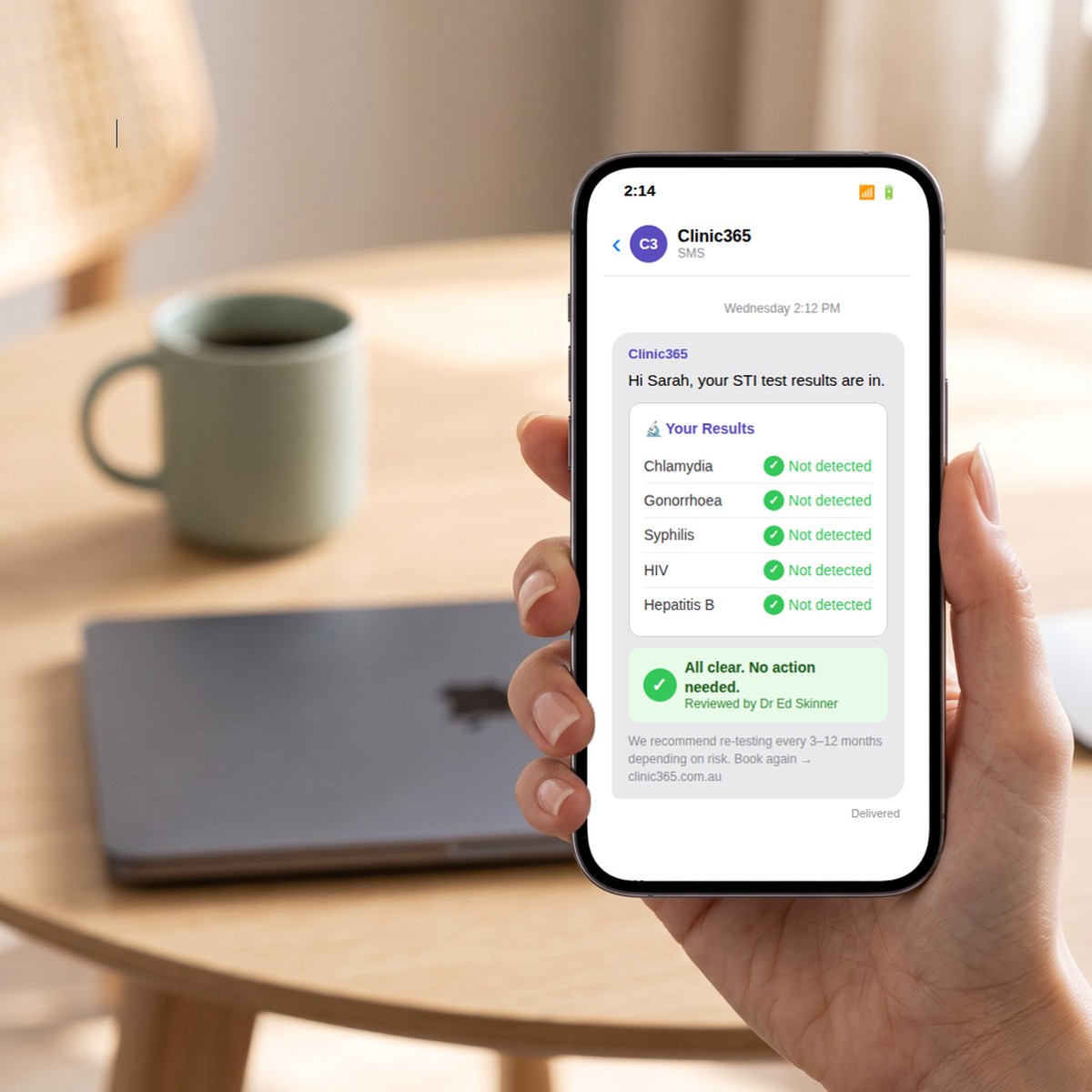
Results by SMS in 3-5 days — telehealth treatment if positive
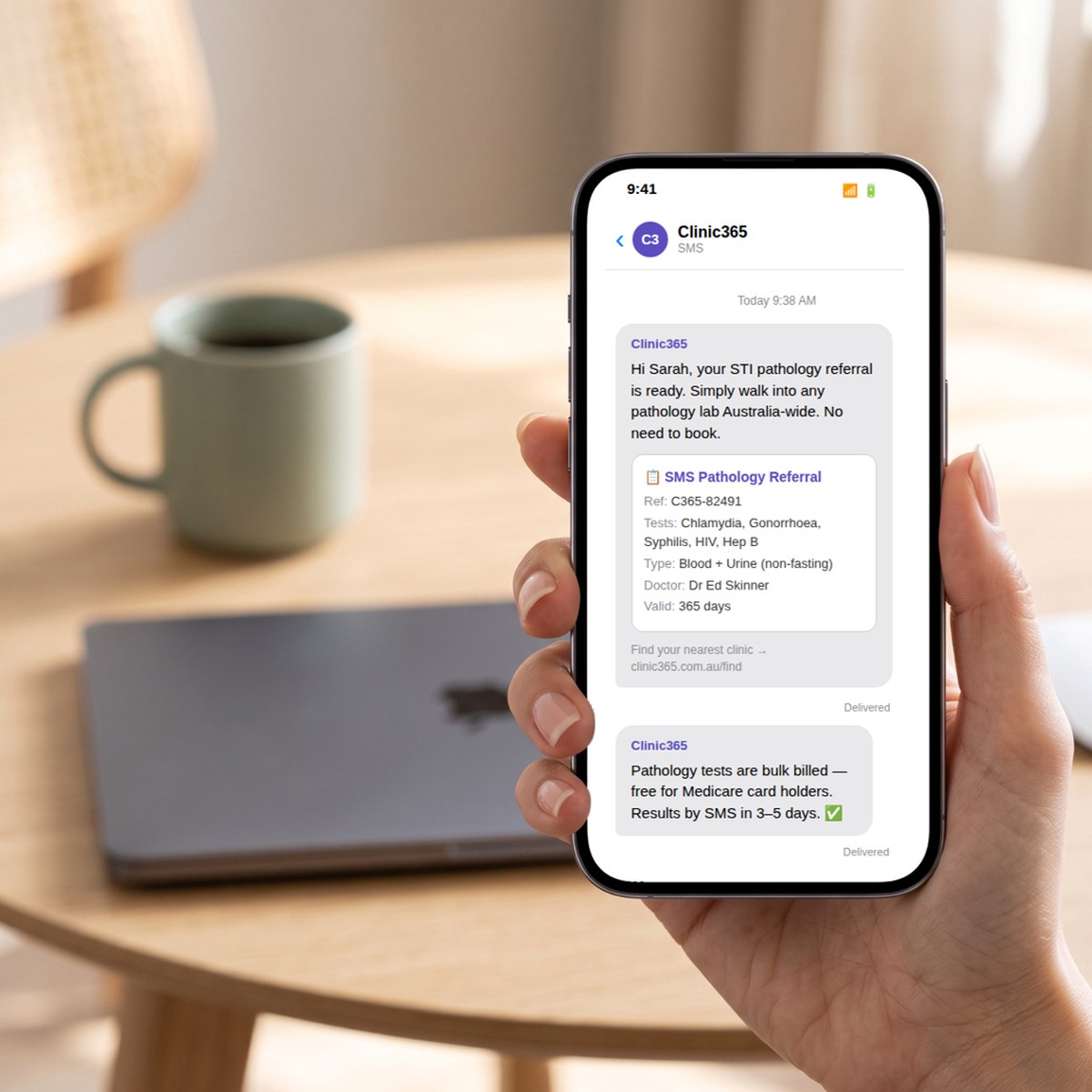
Your pathology referral arrives by SMS — then simply walk into any pathology lab in Sydney to get tested.
Australian Clinical Labs and other major pathology networks run collection centres across Sydney and the surrounding region. Find your nearest on the map above.
📍 Overview
STI/STD Testing in Sydney, Without the Waiting Room
Looking for STI/STD testing in Sydney? You do not need to take time off, sit in a waiting room, or explain yourself at a front desk. As a telehealth sexual health clinic Sydney locals can use from anywhere, we let you speak with a Specialist GP by phone, from home, work, or anywhere across the city, who arranges your STI/STD test at a pathology lab near you. It is private, straightforward, and designed to fit around your life.
Whether you want a routine screen because you are due for a check, you have started seeing someone new, or you have a specific concern, getting tested and treated is genuinely easy this way. Most STIs cause no symptoms, so regular testing is simply part of looking after your health.
⚙️ How It Works
How Our Sydney STI/STD Testing Works
It all happens by telehealth. You speak with a Specialist GP, and there is no in-person clinic visit to book:
Book a telehealth consult, speak with a Specialist GP by phone from wherever you are in Sydney, at a time that suits you.
Get your pathology referral, the GP reviews what you need and arranges the right tests. You walk into any pathology lab in Sydney to have your samples taken.
Results and treatment, the GP reviews your results and, if anything needs treating, arranges it for you by phone.
Speaking with a Specialist GP means your testing is tailored to you: the right tests for your situation, clear advice, and treatment handled properly if it is needed, all without a waiting room.
🩺 Your Screen
What’s Included in Your STI/STD Screen
A standard STI/STD screen checks for the common, important infections:
Depending on your history, testing can also include throat or rectal swabs where relevant, plus other checks a clinician recommends. Because you speak with a Specialist GP, the screen is tailored to you, so if you have symptoms or specific concerns, the right tests are arranged.
📍 Where to Test
STI/STD Testing Sydney: Where You Get Tested
Once you have your pathology referral, you simply walk into any pathology lab or collection centre in Sydney to have your samples taken. There are collection centres right across the city and suburbs, so there is almost always one close to home or work. You do not need an appointment at the lab for most tests: take your referral, provide your sample, and you are done in minutes. Results come back to the clinic, and you are contacted with them, with no need to return anywhere in person.
💊 Treatment
STI/STD Treatment in Sydney
If a test comes back positive, STI/STD treatment in Sydney is arranged for you by phone, with no need to come in. A Specialist GP talks you through your result and organises the right treatment, discreetly and without fuss. Most common infections such as chlamydia, gonorrhoea and syphilis are straightforward to treat, and treatment is arranged promptly so the infection is cleared and cannot be passed on. For infections that need an injection, a clinician will direct you to a convenient option. You will also get clear advice on partner notification and when it is safe to have sex again.
💳 Cost
What It Costs
For Medicare card holders, STI/STD testing in Sydney is free. Your telehealth consult is bulk-billed with Medicare, and pathology at the lab is covered too, so a standard screen costs you nothing. If anything comes back positive, your treatment consult is arranged at no extra cost, because cost should not be a barrier to getting treated. Without a Medicare card, some lab fees may apply, so it is worth checking with the pathology centre you attend. See our full fees for details.
✅ Why Telehealth
Why Choose a Telehealth Sexual Health Clinic in Sydney
A telehealth sexual health clinic offers real advantages over the traditional clinic visit:
No waiting room, organise everything by phone, in private.
Convenient, no time off work or travel across the city; get tested at a lab near you.
Discreet, no front-desk conversations, and your care is confidential.
Fast, testing takes minutes at the lab, and treatment is arranged by phone.
Specialist care, you speak with a Specialist GP, so your testing and treatment are tailored to you.
For most routine STI/STD testing and treatment, telehealth is simply easier, and just as thorough as an in-person visit.
🔒 Confidential
Confidential and Discreet
Your sexual health is private, and it is treated that way. Everything is handled confidentially, from your phone consult through to your results and any treatment. There is no waiting room where you might see someone you know, and no awkward front-desk conversations. Getting an STI/STD screen is a normal, responsible thing to do, and doing it by telehealth keeps it as private and low-key as you would like.
⏰ When to Test
When to Get Tested
It is worth having an STI/STD screen at least once a year if you are sexually active, and more often, every three to six months, if you have new or multiple partners. Testing when you start seeing someone new, so you both know where you stand, is one of the most practical steps you can take. You do not need symptoms to get tested; because most STIs are silent, testing when you feel completely well is exactly the point.
Some symptoms need prompt attention. Book a telehealth consult sooner if you have unusual discharge, sores or ulcers, pain passing urine, pelvic or testicular pain, or unusual bleeding. And if you have had a possible HIV exposure, emergency prevention (PEP) needs to be started within 72 hours, so seek care urgently.
👥 Partners
Telling Partners
If you test positive, recent partners will need testing and treatment too, to prevent reinfection and onward spread. This can be handled confidentially, and there are anonymous options if you would prefer not to tell a partner directly. A Specialist GP can guide you through the best approach for your situation. It is a normal part of the process, and help is there for it.
🗺️ Areas We Serve
Areas We Serve Across Sydney
Because testing happens at a pathology lab near you and everything else is done by telehealth, we serve people right across Sydney and Greater Sydney, including the CBD and inner city, the Inner West, the Eastern Suburbs, the North Shore and Northern Beaches, Western Sydney and Parramatta, the Sutherland Shire, and surrounding areas of New South Wales. Wherever you are in Sydney, there is likely a pathology collection centre nearby, and the rest is handled by phone.
🩺 See a Doctor
When to See a Doctor
Book a telehealth consult with a Specialist GP, or see a doctor, if you have symptoms, a partner has been diagnosed with an STI, or you are unsure what testing you need. Seek care urgently for a possible HIV exposure (for PEP, within 72 hours), severe pelvic or testicular pain, or feeling generally unwell with a fever alongside genital symptoms.
Ready for an STI/STD test or treatment in Sydney? Clinic365 makes it easy: book online or call the team on 1300 222 365. Everything is confidential and judgement-free.
Ready when you are. A Specialist GP can arrange your Sydney STI test by phone, with your referral sent straight to your phone by SMS.
It's all done by telehealth. Book a consult and speak with a Specialist GP by phone, who discusses what you need and arranges the right tests. You then walk into any Sydney pathology lab to be tested. The GP reviews your results and arranges any treatment by phone, so there's no clinic waiting room and no in-person visit.
A standard STI/STD screen checks for chlamydia, gonorrhoea, syphilis, HIV and hepatitis B, the common, important infections. Chlamydia and gonorrhoea are checked with a urine sample or self-collected swab, and syphilis, HIV and hepatitis B with a blood test. Throat or rectal swabs and other checks can be added where relevant, and because you speak with a Specialist GP, the screen is tailored to your situation.
Once you have your pathology referral, you walk into any pathology lab or collection centre in Sydney to have your samples taken. There are collection centres right across the city and suburbs, so there's almost always one near home or work. You don't need an appointment at the lab for most tests: take your referral, provide your sample, and you're done in minutes. Results come back to the clinic.
For Medicare card holders it's free: your telehealth consult is bulk-billed and pathology is covered by Medicare, so a standard screen costs you nothing. If you test positive, your treatment consult is arranged at no extra cost. Without a Medicare card, some lab fees may apply, so check with the pathology centre you attend.
Yes. If a test comes back positive, treatment is arranged for you by phone, with no need to come in. A Specialist GP talks you through your result and organises the right treatment discreetly. Most common infections like chlamydia, gonorrhoea and syphilis are straightforward to treat. For infections that need an injection, a clinician will direct you to a convenient option, along with advice on partners and when it's safe to have sex again.
Yes. Everything is handled confidentially, from your phone consult through to your results and any treatment. There's no waiting room where you might see someone you know, and no awkward front-desk conversations. Getting an STI/STD screen is a normal, responsible thing to do, and doing it by telehealth keeps it as private and low-key as you'd like.
Results usually come back within a few days of your pathology lab visit, and you'll be contacted with them, with no need to return anywhere in person. If anything needs treatment, a clinician will arrange it with you by phone. If your results are all clear, you'll simply be advised when your next screen is due. Timing can vary a little depending on the tests and the lab.
No, and in fact testing when you feel completely well is the whole point, because most STIs cause no symptoms at all. A routine STI/STD screen is for people without symptoms, to catch anything silent early. If you do have symptoms, that's all the more reason to book a telehealth consult so the Specialist GP can assess you and arrange the right tests and treatment.
At least once a year if you're sexually active, and more often, every three to six months, if you have new or multiple partners. Testing when you start seeing someone new, so you both know where you stand, is one of the most practical steps you can take. Regular screening is simply part of looking after your health, and telehealth makes keeping up with it easy.
A positive result isn't a cause for panic, it means the infection has been found so it can be treated. A Specialist GP will talk you through your result by phone and arrange the right treatment discreetly, at no additional cost if you tested positive on one of our STI tests. You'll get advice on notifying partners and when it's safe to have sex again. Most infections are cleared quickly with the right treatment.
Yes. If you test positive, recent partners need testing and treatment too, to prevent reinfection and onward spread. This can be handled confidentially, and there are anonymous options if you'd prefer not to tell a partner directly. A Specialist GP can guide you through the best approach for your situation. It's a normal part of the process and support is there for it.
Seek care urgently for a possible HIV exposure, where emergency prevention (PEP) needs to be started within 72 hours, or for severe pelvic or testicular pain, or feeling generally unwell with a fever alongside genital symptoms. For unusual discharge, sores, pain passing urine or unusual bleeding, book a telehealth consult promptly rather than waiting. When in doubt, it's always better to be checked.























 STI Prevention
 Learn Hub